Showing posts with label Grunwick strike. Show all posts

Friday, November 17, 2017

Permanent tribute to the ‘lions’ of Grunwick


last month's unveiling ceremony

FOUR decades after an initially unremarkable local dispute over working conditions in a small north-west London factory exploded into one of longest, bitterest and most influential industrial showdowns in British industrial history, the so called ‘lions of Grunwick’ have been immortalised in major new public artworks.
Led mainly by Asian women, the iconic Grunwick dispute of 1976-78 challenged not just stereotypes but also the ethos of the predominantly white, male trade union movement of the day and, in the process, inspired a generation to speak out against injustice.
           Amongst the tens of thousands who flocked to the cause of the Grunwick strikers and their inspirational leader, Jayaben Desai, were postal workers from the then Cricklewood branch of the UPW (Union of Post Office Workers).
Twice their refusal to deliver or collect mail cut the jugular of the mail-order photo processing operation after its fervently anti-union owner sacked his striking workforce after they refused to drop their demand for trade union representation.
Quickly becoming a cause celebre of trade unionism and labour relations law, at its height the dispute was reported nightly on the national television news, with footage of the Metropolitan Police’s Special Patrol Group (SPG) making mass arrests and violently confronting the “strikers in saris”, as they were dubbed by the media of the day, further enflaming tensions.
Former Cricklewood branch chair Colum Moloney still vividly recalls the brutal treatment dished out to those on the Grunwick picket line – a precursor in many ways to the horrific scenes that unfolded in the subsequent Miners’ Strike
“The SPG were animals – more like an army than anything,” he told The Voice last autumn in an interview marking the 40th anniversary of the start of the Grunwick dispute.
A year on, Colum has just represented the Cricklewood postal workers who did so much to provide moral and industrial support to the Grunwick strikers at the unveiling of two large murals in Willesden that unapologetically portray the heroic stand of the predominantly female workforce who unwittingly found themselves centre stage in a wider schism in British society that directly preceded the 1979 general election and intensified under the Thatcher government.
Describing the murals as a long overdue “tribute to the strikers and all those who supported a just cause,” Colum stressed he was proud to represent his erstwhile colleagues at an event which illustrated the extent to which the ultimate moral victory is now seen to lie with the Grunwick strikers – despite their ultimate defeat in the dispute itself.
The celebratory murals, which were developed by over 80 local residents through a series of community workshops with local artist Anna Ferrie, sit at two locations with direct associations with the dispute.
One adorns a wall directly adjacent to the former Grunwick factory site in Chapter Road, while the second, larger, mural is at the railway bridge in Dudden Hill Lane near Dollis Hill tube station where many of those supporting the strikers from across London and beyond disembarked en-route to the picket line.
One of the most astonishing things about the Grunwick dispute is how a showdown that was so bitter and controversial in the late 1970s is seen as a cause for mainstream celebration of the spirit of struggle today – to the extent that the Grunwick 40 commemoration project, of which the murals are the permanent legacy, was part funded by a £24,800 Heritage Lottery Fund grant.
“Maybe the further back in time it is the less controversial Grunwick has become,” observes CWU retired member and Brent Trades Council chair Pete Firmin who regularly supported the strikers on the picket line.
“For me the ultimate legacy of Grunwick is the way in which it was a turning point in terms of the unions relating to migrant workers and black workers,” he added.
“It’s great to have a memorial to the strike, the strikers and their supporters so close to the site of the old Grunwick factories. It’s a wonderful reminder of an important piece of local and labour movement history.  A job well done by artist Anna Ferrie together with all those who participated in community workshops to help design the mural.”

Thursday, September 21, 2006

The legacy of Grunwick


by Rob Laurie

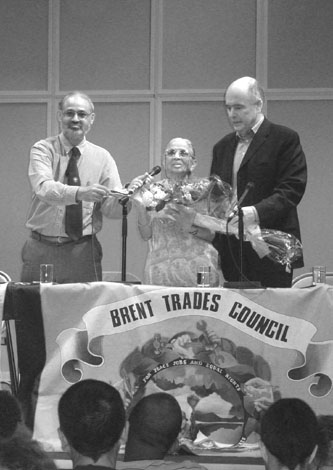
LAST SUNDAY Brent Trades Union Council organised a commemoration of the 30th anniversary of the epic two year Grunwick strike. In August 1976 a small group of unorganised Asian workers walked out of their low paid jobs at a north London film processing factory in protest at being denied union recognition by their ruthless boss, George Ward.
The workers soon joined APEX (now part of GMB) and were greatly assisted by Brent Trades Council, then chaired by the late Tom Durkin, the legendary building workers’ leader and whose secretary was Jack Dromey, who is now deputy general secretary of the Transport and General Workers’ Union.
Grunwick’s was a postal business, so it was badly damaged by the boycott of its mail by the postal workers, who supported the strike.
The misnamed National Association For Freedom took legal action to force the postal union to drop the boycott in return for negotiations with the conciliation service ACAS.
It soon became clear that George Ward merely saw this as a stalling tactic and continued to oppose recognition. The pickets remained at the factory gates their numbers increasing.
In June 1977 the 250-odd pickets were attacked by police and 84 arrested.This did not deter the trade union movement, but only served to multiply the number of pickets to 3,000 by the end of the week.
These pickets included miners from South Wales and Yorkshire, the latter lead by Arthur Scargill. The bourgeois media took fright at this wave of support for the workers and the leadership of the unions began to get cold feet.
The leadership of postal workers forced the local postmen to abandon their boycott. The Labour government launched a Court of Inquiry which would divert the struggle from the streets to the courts.
This did dot deter the Strike Committee from holding a 12,000 strong mass picket on the 11th July, but this proved to be the high water mark of the dispute.
The Court of Inquiry, which reported in late August, largely supported the strikers but Grunwick’s boss, supported by the Tory Party, repudiated it.
The national union leaderships made every effort to prevent mass action but the local strike committee organised mass pickets in November.
The strikers held a hunger strike outside the TUC on the day the GeneralCouncil met. War weariness set in among even the most militant supporters.Legal procedures proved ineffective in forcing George Ward to recognise unions.
The lessons of the dispute are clear: the workers can never depend on the courts to secure their rights. The legal environment was much friendlier into trade unions in 1976 than it is in 2006, but still the battle was lost.
While the workers ultimately failed to achieve their objectives they were not defeated in any meaningful sense. The workers speedily learned a great deal about trade union organisation and they have served as an inspiration to countless other black workers.
The dispute was a turning point for the trade union movement in that it developed a militant unity between black and white workers.
Sunday’s commemoration brought together a number of veterans of that dispute. Prominent personalities such as former miners’ leader Arthur Scargill and Jack Dromey shared the platform with local postal workers’leader Derek Walsh, but the star turn was however the original leader of the walkout, Jayaben Desai.
The event did not focus entirely on the historical aspects of the dispute.After a delicious Indian lunch there were two separate workshops focused on the continuing struggle trade union rights and those on migrant workers.
John Hendy QC, the author of the present Trade Union Freedom Bill, recalled being on the Grunwick picket line, in particular the sight of the famous labour lawyer John Platt-Mills turning up in pinstripes and bowler hat.
Hendy stressed the limited aims of the Trade Union Freedom Bill which he saw as an essential first step in restoring the rights of British workers tothose required by the United Nations charter.
In the latter session two women involved in the recent Gate Gourmet dispute at London Airport accused the TGWU of betrayal. This brought a sharp rebuke from Jack Dromey who described the considerable resources devoted by his union to organising migrant workers, including employing a large number of ethnic organisers who deal with migrant workers in their own language.

Brent Trades Council has produced two lasting souvenirs of these events.They have reprinted a pamphlet first published in 1978 by Tom Durkin aptly entitled Grunwick: bravery and betrayal; it costs £2.00. They have also given fresh life to two contemporary films of the strike by putting them out on a single DVD entitled The Grunwick Strike 1976-1978 which retails for a bargain £6.00. Both these can be obtained from Brent Trades Union Council,375 High Street, Willesden, London NW2 2JR, who will doubtless welcome acontribution towards postage and packing.