Friday, September 29, 2006

Dump Blair Now!

NCP comrades and supporters from Manchester, London and Bristol gathered in Manchester last Saturday to march with the Central Committee banner with many thousands of other protesters to demand an end to the war in Iraq. The demonstration of the eve of Labour Party conference in Manchester centred around the call for Troops Out of Iraq, Don't Attack Iran and No Trident Replacement. Whether the Labour Party leadership will take any notice remains to be seen. Hundreds of NCP leaflets were given out and a large number of New Workers sold during the march.

The latest issue of the NCP's London bulletin, the London Worker (September 2007) is out now and costs just 20p. For your copy just send your name and address together with a first class postage stamp to: London Worker, NCP, PO Box 73, London SW11 2PQ.

Thursday, September 21, 2006

The legacy of Grunwick


by Rob Laurie

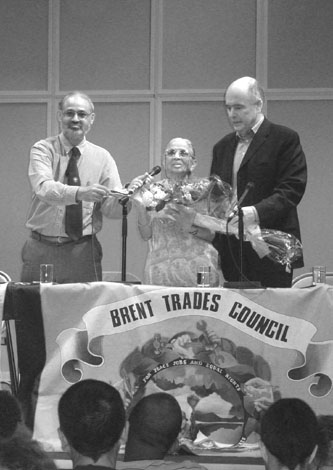
LAST SUNDAY Brent Trades Union Council organised a commemoration of the 30th anniversary of the epic two year Grunwick strike. In August 1976 a small group of unorganised Asian workers walked out of their low paid jobs at a north London film processing factory in protest at being denied union recognition by their ruthless boss, George Ward.
The workers soon joined APEX (now part of GMB) and were greatly assisted by Brent Trades Council, then chaired by the late Tom Durkin, the legendary building workers’ leader and whose secretary was Jack Dromey, who is now deputy general secretary of the Transport and General Workers’ Union.
Grunwick’s was a postal business, so it was badly damaged by the boycott of its mail by the postal workers, who supported the strike.
The misnamed National Association For Freedom took legal action to force the postal union to drop the boycott in return for negotiations with the conciliation service ACAS.
It soon became clear that George Ward merely saw this as a stalling tactic and continued to oppose recognition. The pickets remained at the factory gates their numbers increasing.
In June 1977 the 250-odd pickets were attacked by police and 84 arrested.This did not deter the trade union movement, but only served to multiply the number of pickets to 3,000 by the end of the week.
These pickets included miners from South Wales and Yorkshire, the latter lead by Arthur Scargill. The bourgeois media took fright at this wave of support for the workers and the leadership of the unions began to get cold feet.
The leadership of postal workers forced the local postmen to abandon their boycott. The Labour government launched a Court of Inquiry which would divert the struggle from the streets to the courts.
This did dot deter the Strike Committee from holding a 12,000 strong mass picket on the 11th July, but this proved to be the high water mark of the dispute.
The Court of Inquiry, which reported in late August, largely supported the strikers but Grunwick’s boss, supported by the Tory Party, repudiated it.
The national union leaderships made every effort to prevent mass action but the local strike committee organised mass pickets in November.
The strikers held a hunger strike outside the TUC on the day the GeneralCouncil met. War weariness set in among even the most militant supporters.Legal procedures proved ineffective in forcing George Ward to recognise unions.
The lessons of the dispute are clear: the workers can never depend on the courts to secure their rights. The legal environment was much friendlier into trade unions in 1976 than it is in 2006, but still the battle was lost.
While the workers ultimately failed to achieve their objectives they were not defeated in any meaningful sense. The workers speedily learned a great deal about trade union organisation and they have served as an inspiration to countless other black workers.
The dispute was a turning point for the trade union movement in that it developed a militant unity between black and white workers.
Sunday’s commemoration brought together a number of veterans of that dispute. Prominent personalities such as former miners’ leader Arthur Scargill and Jack Dromey shared the platform with local postal workers’leader Derek Walsh, but the star turn was however the original leader of the walkout, Jayaben Desai.
The event did not focus entirely on the historical aspects of the dispute.After a delicious Indian lunch there were two separate workshops focused on the continuing struggle trade union rights and those on migrant workers.
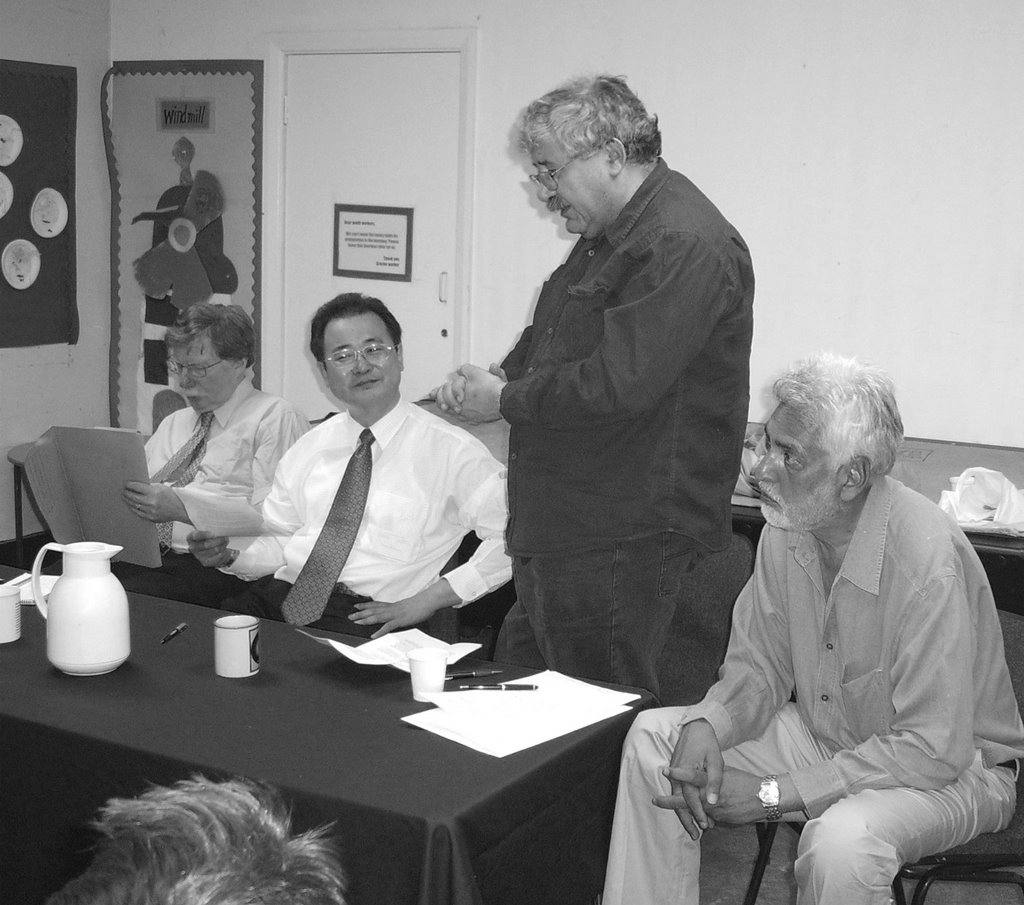
John Hendy QC, the author of the present Trade Union Freedom Bill, recalled being on the Grunwick picket line, in particular the sight of the famous labour lawyer John Platt-Mills turning up in pinstripes and bowler hat.
Hendy stressed the limited aims of the Trade Union Freedom Bill which he saw as an essential first step in restoring the rights of British workers tothose required by the United Nations charter.
In the latter session two women involved in the recent Gate Gourmet dispute at London Airport accused the TGWU of betrayal. This brought a sharp rebuke from Jack Dromey who described the considerable resources devoted by his union to organising migrant workers, including employing a large number of ethnic organisers who deal with migrant workers in their own language.

Brent Trades Council has produced two lasting souvenirs of these events.They have reprinted a pamphlet first published in 1978 by Tom Durkin aptly entitled Grunwick: bravery and betrayal; it costs £2.00. They have also given fresh life to two contemporary films of the strike by putting them out on a single DVD entitled The Grunwick Strike 1976-1978 which retails for a bargain £6.00. Both these can be obtained from Brent Trades Union Council,375 High Street, Willesden, London NW2 2JR, who will doubtless welcome acontribution towards postage and packing.

Tuesday, September 19, 2006

Soviet Remembrance day

PAUL Kyriacou, the Mayor of Southwark and Philip Matthews of the Soviet Memorial Trust Fund last Sunday led a ceremony of remembrance at the Soviet war memorial, in the grounds of the Imperial War Museum, for the 27 million Soviet citizens killed in the Great Patriotic War against Nazi Germany. This year marks the 65th anniversary of the Battle of Moscow, considered to be one of the greatest battles of history. Nazi forces attempting to capture Moscow were halted and thrown back by the Soviet counter-offensive, which began on 5th December 1941. Wreaths were laid by the Mayor, by the local MP Simon Hughes, on behalf of the House of Commons, and by the Ambassador of the Russian Federation. Others who laid wreaths included the ambassadors of the Ukrainian Republic, Belarus, Turkmenistan, Kazakhstan and other former Soviet Republics; a representative of the RAF Russia Association, the Royal British Legion, the local branch of the trade union Ucatt and the Russia Convoy Club. The event was organised by the Soviet Memorial Trust.

Turnham Green Peace Market

TURNHAM Green Peace Market made history in 2006 with two markets instead of the single market held since the West London Peace Council set up the market in 1979.
Maybe it was the weather last weekend but the second market had the Green covered in stalls and a good attendance.
Once again Southall New Communist Party put up its stall with a good stock of home-made marmalade and a variety of jams made from lush fruit from the Vale of Evesham in Hereford-Worcester.
But a display of Marxist-Leninist literature on display competed for public attention with the jams.
Comrades working at the stall watched with interest as customers bought copies of Stalin’s Foundations of Leninism and his famous Dialectical and Historical Materialism.
Ernie Trory’s booklets on Hungary and Poland and Churchill and the Atom Bomb also drew a lot of public interest.
And people came to talk to us. Labour Party comrades spoke rather apologetically about the failure to run stalls in 2005 and 2006 but they hoped to do better in 2007. “See you next year,” they said.
Ten copies of the New Worker were sold, helping to give an overall profit of £55.

Saturday, September 02, 2006

Dagenham BNP councillor evicted for unpaid rent

CLAIRE Doncaster, one of the British National Party’s successful candidates in last May’s local elections in Dagenham, was evicted from her council home last week for failing to pay her rent.
Now Councillor Doncaster’s position as an elected member of the council is in jeopardy. She owes more than £2,000 in rent.
After bailiffs evicted her last week Councillor Doncaster from her flat, she moved in with her parents. Her mother, Sandra Doncaster, is also a BNP councillor – and she is also under threat of eviction for unpaid council tax.
The council members’ code of conduct says: “A member must not in his/her official capacity, or in any other circumstance, conduct themselves in a manner which could reasonably be regarded as bringing their office or authority into disrepute.”

South West Trains strike solid

by Caroline Colebrook

TRAIN drivers employed by South West Trains walked out on a 24-hour strike last Tuesday, crippling commuter services on some of the busiest routes into London.
Keith Norman, general secretary of the train drivers’ union Aslef thanked all his members who had taken part in the strike but put the blame for the dispute firmly on the employer, who, he said, “preferred a punch-up to a settlement”.
The dispute is the result of a number of issues, which include the high-handedness of SWT management.
The conflict began with a small, local dispute in Waterloo, where there was a disagreement over the company providing taxis for drivers on early and late duties.
Aslef says this could have been easily settled, “but we believe management engineered a dispute”. During the resulting action, SWT drafted in managers to drive trains.
This was in direct contravention of an existing agreement which says managers will only drive trains in cases of health, safety or the possibility of civil unrest.
The union was also concerned at the safety risks: one manager, although technically competent, had not driven a train alone for a decade. The union accused the company of being more concerned with scoring industrial relations points than with the safety of passengers.
The dispute was then inflamed when it was shown that SWT was bringing in managers to drive trains from as far away as Bournemouth – and, to add insult to injury fetched them in by taxi!
Aslef accordingly held a ballot of all its members in SWT which overwhelmingly supported the industrial action. Keith Norman said it was astonishing that since he had informed the company of the intention to strike, SWT had only approached the union at national level to make legal threats – and not to seek discussions aimed at reaching an agreement.
SWT management claimed to be running one train in 10 but the union described this as “wishful thinking” and dismissed it as propaganda.
Speaking on most national radio stations on Tuesday morning, Keith Norman accused management of “wanting a punch-up and using the public as its boxing-gloves”.
He said SWT had spent masses of money on legal threats and newspaper adverts – but had made no attempts to sit down and negotiate a settlement.
“I have been in London all weekend prepared to speak to the company,” he said, “but they have been too busy making excuses to do anything positive. The union has shown its organising abilities today – but I’m sure the public would prefer us to be demonstrating our negotiating skills.
“Unfortunately, this would involve management coming to the table – which it is reluctant to do.”
Keith Norman said the union cannot allow management to disregard agreements it has entered into. “When we shake hands, we deliver. When they make an agreement they apply it if its convenient.
“Industrial relations cannot function like that. Today we were forced to make a stand.”
The union’s national organiser Andy Reed said the strike was solid in the areas around Portsmouth and Basingstoke which he visited this morning.
“None of our members wanted this,” he said, “but they are not the sort of people who can be threatened or intimidated.”
A guard on one service told the union one 12-coach train, driven by a manager, had pulled into a nine-coach platform at Waterloo –endorsing the union’s safety arguments.

East London hospital strike

PORTERS, cleaners and switchboard staff employed by Rentokil Initial, based at Whipps Cross Hospital in East London, have been on strike since 21st July.
An agreement over pay and conditions was made in 2003, due to come into force in April 2006; several other East London hospitals agreed to the deal, only Rentokil at Whipps Cross has failed to honour it.
The pay award is roughly equivalent to a £2 per hour raise, for staff who in some cases earn as little as £5.52 per hour, the agreement also included increases in leave entitlement.
Staff are on strike for the full award with pay backdated to April. Over 300 staff are employed by Rentokil Initial at Whipps Cross, and around 270 are members of the public sector union Unison.
So far there have been four days of strike action, with the strike days increasing from one to two days every other week over the past month. Rentokil has refused to discuss the deal with either the workers directly or with Unison, although some negotiations are planned with the hospital trust itself.
In light of this, strike days were increased from two to three in the next round of action on 29th August, and there is likely to be all out indefinite strike action during September if no deal is made.
The dispute is restricted to Whipps Cross at the moment, since it’s a local deal, which only Rentokil Initial has not met.
However a Unison member at the hospital told me that a national agreement is due to come into force in October, which Rentokil is unlikely to meet. This could lead to the dispute spreading nationally to all Rentokil Initial hospital staff during October.
One picket line worker said: “Everyone’s been out here every day, we don’t expect to have an offer at all, but we’ll be here again tomorrow and keep doing it as long as necessary, it’s been a really good atmosphere out here.”
The turn out on the picket line has been consistently over 200 people per day, starting at 6am and finishing around 5 or 6pm.
Only five Initial Rentokil workers employed at the hospital have crossed the line since the first day of the strike, many workers who were not members of Unison have joined the action unofficially or joined since it started.
But company has been shipping in employees from all over London and even Brighton as scab labour, in some cases putting them up in hospital accommodation.

Wednesday, August 16, 2006

Labour Representation Committee Conference

Planning for the Post-Blair era

THE MAIN item on the agenda at the annual conference of the Labour Representation Committee in London last month was MP John McDonnell’s announcement that, on Tony Blair’s retirement as prime minister, he would stand against Gordon Brown as successor.
This would force a vote and a full debate of policies within the Labour Party. All individual members would have to be balloted and all affiliated unions would have to ballot their members.
Given the current level of dissatisfaction among Labour rank and file members with both Blair and Brown, this would mean that Brown’s succession would be far from secure. It could lead to a dramatic change in the party and its policies.
The current LRC has now been in existence for just two years and is based on the historic Labour Representation Committee that first founded the Labour Party.
The conference began with a review of the LRC’s progress since last year’s conference. Individual membership now exceeds 1,000; it has more than 100 affiliated organisations and claims to be the biggest rank and file left Labour organisation.
Among those attending the conference were four delegates from the New Communist Party, which is affiliated to the LRC.
The LRC issued an executive statement for the conference, which said: “The Blair era is slowly grinding to an end. It is increasingly accepted that within 12 to 18 months the Prime Minister will resign. Events my even overtake him sooner. This presents the Left with two serious challenges:
“First, how the Left responds to the present attempt by the Prime Minister to secure in his last months his ‘legacy agenda’.
“Second, how the Left challenges for the future of the post Blair Labour Party.”
It covers the New Labour intentions to eradicate the last vestiges of the social and political model inherited from past labour governments and to install the foundations of a market state.
And it issues a call: “For the next 12 to 18 months the aim of the Left must be to campaign in the party, in our unions and in every organisation available to us to hold back the ‘legacy agenda’ of privatisations, attacks on civil liberties and nuclear risk.
“The LRC commits itself to supporting at local and national levels campaigns to protect public services such as ‘Keep the NHS Public’ and ‘Public Services not Private Profit’.”
This statement was endorsed unanimously – as were 10 other resolutions submitted by affiliated organisations.
These included opposition to state funding of political parties or a cap on donations – which would undermine the link between the unions and the party.
Other resolutions called for the renationalisation of the rail transport system, commitment to public services, opposition to civil service cuts, for a Trade Union Freedom Bill, support for lesbian, gay, bisexual and transgender rights, opposition to the “war on terror”, support for Venezuela and an emergency resolution on the Middle East.
But the key resolution, on which all the others hinged, was backing for John McDonnell’s leadership challenge.
If this succeeds, it could result in a Labour leadership both willing and able to implement all the other resolutions.
Among the organisations present at the conference were the Fire Brigades Union and the RMT transport union. Both of these unions are no longer affiliated to the Labour Party in protest at cuts and privatisation policies which have had an adverse effect on union members. The PCS union, which never was affiliated to the Labour Party, was also there.
There were calls for these unions to affiliate to the Labour Party in order to play a fuller role in fighting for change. The three general secretaries – Matt Wrack, Bob Crow and Mark Serwotka – indicated their personal agreement.
This was a conference marked by its unity of purpose and without divisions or splits. There were rousing speeches from John McDonnell, veteran campaigner Tony Benn, Jeremy Corbyn MP, Bob Wareing MP, Alice Mahon MP, Lyn Jones MP, RMT general secretary Bob Crow, FBU general secretary Matt Wrack, PCE general secretary Mark Serwotka and NUJ general secretary Jeremy Dear.
John McDonnell and Tony Benn were both cheered when they expressed outrage at Tony Blair’s joining George Bush in being the only two national leaders outside of Israel to fail to condemn the bombing of Lebanon or call for an immediate ceasefire.
“The US and Britain are totally isolated in not calling for a ceasefire. Bush could stop this war immediately with one phone call,” said McDonnell.
And explaining his decision to challenge Brown for the leadership of the party, he said: “I did not work for 18 years to get rid of the Tories to elect a Labour government that would privatise more jobs in 10 years than the Tories did in 20.”

Hiroshima Day in London

By New Worker Correspondent

ON THE 6th August 1945 the American Air force dropped an atomic bomb on the Japanese city of Hiroshima, causing the deaths of about 100,000 people leaving countless others to die over the coming decades of radiation related illnesses.
Three days later Nagasaki suffered a similar fate. Since 1967 the Campaign for Nuclear Disarmament has organised an annual commemoration of these terrible events in London’s Tavistock Square, which itself was the site of the bomb which killed 13 people on number 30 bus in July last year.
The ceremony was chaired by Left Labour MP Jeremy Corbyn, who is also Vice Chair of CND. It began with the Liberal Mayor of Camden laying a wreath to the victims.
Veteran pacifist Pat Arrowsmith then read two of her poems while the Workers’ Music Association and Raised Voices choirs sang a number of Japanese and English songs.
The Vicar of nearby St Pancras Church, a priest from the Battersea Park Peace Pagoda and an Imam from the Interfaith Alliance UK all spoke in favour of nuclear disarmament.
Two speakers were from the opposite ends of the age spectrum: 100-year old Rose Hacker, a long-time peace activist and Labour Party member was followed by 11-year-old Sonia from Children Against the War.
Near the end of the ceremony former Labour MP Tony Benn reminded the audience that the dropping of the atomic bombs was not carried out to defeat the Japanese who were already on their knees, but were the intended as a warning to the Soviet Union. They were in fact the first acts of the Cold War.
Benn was one of several a speakers to stress that in the coming months every effort has to be made to prevent Blair, or whoever succeeds him, from committing this country to a replacement for Trident missiles.

Monday, July 24, 2006

Remembering the heroes who fought fascism in Spain

by Rob Laurie

SEVENTY years ago this month General Franco led a revolt of the Spanish Army against the Popular Front Government elected the previous February. Thus began what is known as the Civil War in Spain – but which is more accurately named the Spanish War Against Fascism – which was to last three years before the fascists triumphed.

This was due to the massive open support of Hitler and Mussolini, to say nothing of the covert support from Britain and other bourgeois democracies.

The Spanish Republic did fight not alone; support came from the Soviet Union and the International Brigades which were formed of volunteers who came from across the globe.

Britain sent 2,100 volunteers to fight against the fascists. Of these 526 died in battle. Today only 24 are still alive.

Contrary to the impression given in the capitalist media the volunteers were not all poets and other gilded youth whose later memoirs greatly exaggerated their role.

The Brigaders were largely working class: among them were Welsh miners, Clydeside engineers and working class Jewish veterans of the struggles against Oswald Mosley in the East End of London.

Last Saturday this heroic struggle was remembered at a ceremony at the International Brigade Memorial under the gaze of the London Eye in south London.

This year the ceremony was important for the first ever attendance of the Spanish Ambassador, Carlos Miranda, which represented a long overdue official recognition by the Spanish government of the efforts made by the International Brigade in the war and afterwards when they campaigned for the political prisoners held in Franco’s jails.

He praised the Brigaders for their role in bringing about Spain’s present democratic constitutional monarchy. While this may not have been the aim of the Brigaders who were largely Communists, they can be credited with encouraging the Spanish people’s resistance to the fascist system which did not long outlive General Franco.

The well attended event was chaired by Jack Jones, former general secretary of the Transport and General Workers’ Union, himself a Brigader. Among the seven veterans present was Penny Fyvel who served as a nurse in during the war.

There were three wreaths laid. The Spanish Ambassador laid one; a representative of the Jewish ex-servicemen’s organisation, AJAX, laid another and Connie Fraser laid the third on behalf of the International Brigade Memorial Trust – who organised the ceremony.

Bob Doyle, the last surviving Irishman to fight in Spain was also present to sign copies of his recent autobiography Brigadista. While the main speaker was Rodney Bickerstaffe, the former general secretary of Unison, Sam Russell, another Brigader, recited Cecil Day-Lewis’s poem The Volunteer.

He also called upon the large audience to remember the role of women who served as ambulance drivers and nurses. The meeting also saw the launch of a new anthology of poetry written by veterans and edited by Jim Jump.

Menezes family continue fight for justice

THE CROWN Prosecution Service last week ruled that there was not enough evidence to bring criminal charges against any police officers involved in the shooting of Jean Charles de Menezes last July. Instead they decided to prosecute the Metropolitan Police under health and safety laws.
But the family of the young Brazilian, mistaken for a terrorist suspect, who was shot and killed on a Tube train at Stockwell Underground Station on 22nd July 2005, say they will continue to campaign for those involved to be brought to justice. unbelievable
Alex Pereira, a cousin of Jean de Menezes, said the CPS decision was “completely unbelievable”. He talked about the decision with Menezes’ family in Brazil.
“They are shocked about the decision,” he said. “They are completely disappointed about what they heard this morning.”
Another cousin, Patricia da Silva Armani, who lived in London with Menezes, said: “I am very disappointed. I was expecting a negative reply and it is shameful. My cousin was shot; they took his life inside an Underground station. “The authorities, in reality they did not have any shame. I feel sickened by that.”
London mayor Ken Livingstone commented: “Health and safety legislation was simply not drawn up to deal with policing a city facing the terrorist threat of 7th July.
“And it makes absolutely no sense to apply such legislation in the case of such an extreme situation.” got stuck
Meanwhile new evidence has emerged that the police unit involved in the shooting stopped for petrol on their way to Stockwell Tube station and then got stuck in heavy traffic as they were supposed to be following a terrorist suspect travelling by bus towards the station.
The delay led to these officers arriving too late at the station to stop Menezes boarding a train. Since they believed at the time that he was an Arab suicide bomber, they felt they had no option but to resort to a shoot-to-kill policy. The Menezes family is now considering their next step forward in their fight for justice.

Friday, July 14, 2006

Call to close detention centres

PEOPLE held in London’s Colnbrook Detention Centre last month issued a statement calling for the closure of all detention centres and declared a hunger strike in protest against inhuman treatment.
They describe three types of prisoner being held there. The first of these are asylum seekers; refugees who fled their native country, forced to abandon their families to save their lives.
All they want is to survive and live in safety. They have always complied with the conditions given them. They were detained when they went to make their weekly report in the immigration office, and since then they have been at Colnbrook IRC.
They are held for many months in the centre for no crime and are deprived of all contact with their families.
The second group who suffer are disabled asylum seekers who have been unable to earn a living. They suffer particularly because there are no facilities for disabled prisoners and they do not receive proper medical attention. The third group, a minority, consists of those who have committed offences – for example using a forged passport – served their sentence in prison and are then held indefinitely in the detention centre – sometimes for twice the length of their original sentence.
They are in a legal limbo and have no idea what will happen to them. They feel they are being used as political scapegoats.
Some are suicidal. Their statement says: “We have repeatedly called for help and intervention, for an investigation of these crimes against humanity. We have appealed and will continue to appeal to whoever is willing to listen, to come to our aid, and exert some control, and restraint on this organisations.”
They have embarked on the hunger strike to draw attention to their plight. They are asking for an audience with immigration minister Liam Byrne MP; for an independent parliamentary committee to investigate their situation and for temporary work permits in order to earn a living.
But already one of the hunger strikers has been seized and taken from his cell by 20 police officers. He is a married man with a wife and children who have legal status in Britain and his case was due for a judicial review. Now his friends and family have no idea where he is.

Friday, July 07, 2006

7th July Compensation 'hypocrisy'

A LONDON TUBE driver awarded the MBE for his selfless efforts in helping victims of the 7th July bombings at two stations has slammed the “hypocrisy” of ministers seeking to axe compensation to workers injured at work through criminal actions.

John Boyle, a member of the RMT transport union, who was off-duty when he rushed to aid the injured at both Aldgate and Aldgate East stations, received £1,000 in compensation from the Criminal Injuries Compensation Authority (CICA) for the serious effects of the trauma he suffered.

But the Home Office has proposed not only that CICA’s minimum tariffs be removed, but that workers injured through criminal actions at work should not qualify for CICA compensation at all.

“The Government’s proposals are just terrible,” says John Boyle. “I was off-duty when the bombs went off, so under these proposals I might still have had a claim, but my workmates and all the emergency services people who did so much wouldn’t qualify at all just because they were on duty.

“How can they say that people injured in the course of duty are different to those injured off-duty, or on their way to work?

“We were all victims that day, and it is appalling that they are trying to find money to pay to people more seriously injured by taking it away from others.

“To call people heroes and then to try to bar them from claiming compensation looks like hypocrisy to me,” John Boyle says.

“Penalising victims of criminal acts is plain wrong and the Government really should just drop these proposals,” said RMT general secretary Bob Crow in Dublin as delegates gathered for the union’s annual general meeting.

“Thompsons, our lawyers, have already made a number of CICA applications on behalf of our members, but people who were affected should get in touch with the union and get a claim in as soon as possible,” Bob Crow said.

Mubarak Inquiry -- 'Institutional Murder'

THE OFFICIAL public inquiry into the racist murder of teenager Zahid Mubarak as he slept in his cell in Feltham Institute for Young Offenders in 2000 ended last week with a list of damning indictments of the prison service.

The family of the murdered youth, who was to have been released the morning after his death, had their own verdict. They accused the prison service of “institutional murder” for placing their son in a cell with a young racist with a long history of violence and mental illness.

The family had to fight for six years and take the Government to court to force a public inquiry, in spite of Government attempts to block it. Family lawyers said they were now exploring the possibility of suing individuals named in the report.

Mubarak’s mother Sajida Mubarak said her son’s death was the result of chronic incompetence. “The Home Office and the prison service, both before and after Zahid’s death, were co-conspirators in a woeful conspiracy of incompetence and indifference,” said lawyer Dexter Dias.
“The prison service had 15 chances to save Zahid from his killer. It squandered them all. The report has convinced the family that Zahid’s death was no more and no less that institutional murder.”

One of the main inquiry conclusions was that either more money must be found for the prison service or fewer people must be sent to prison. It highlighted 186 failings in the prison service that led to the murder.

Mr Justice Keith, who conducted the inquiry, spoke of “a bewildering catalogue of shortcomings, both individual and systemic” and a breakdown in communications between different sections of Feltham which meant that crucial information about Stewart, the young murderer, were not passed on, mislaid or not acted on.

Mubarak had requested a change of cell the day before his death because he did not feel safe locked up with Stewart. But there was plenty of clear evidence that Stewart was so dangerous he should not have shared a cell with anyone.

And Stewart himself had a long record of violence and mental illness, going back to his disturbed childhood, that was never addressed and he never received any mental health treatment. Instead he spent most of his youth in various young offenders’ institutions.
He exhibited bizarre behaviour, including self harm, swallowing batteries, flooding his cell and talking to walls. In an institute near Wigan he met and befriended violent racist Maurice Travis. Two years before Zahid’s murder, Travis was convicted of stabbing a fellow prisoner to death while he and Stewart were both at Stoke Heath Young Offenders’ Institute while Stewart was present.

The prison service missed many warnings, including letters written by Stewart fantasising about racial violence and killing his cellmate.

Mr Justice Keith said: “Because of a dangerous and pernicious cocktail of poor communications and shoddy work practices, prison staff never got to grips with him.”

Stewart was moved to Feltham at a time when it was seriously overstretched and overcrowded. Keith said: “Feltham was being asked to do too much with too few resources. It did not have the number of staff needed to keep pace with its increasing population.”

The prison also suffered from institutional racism and a failure to deal with racism. The inquiry found that the security department was in chaos and that some key staff suffered a lack of initiative and defeatism. The officer who put Stewart into Zahid’s cell was inexperienced in cell allocation. Other members of staff who knew of Stewart’s racist letters failed to raise the matter appropriately. The greatest concern to Zahid’s family is that the overcrowding and lack of resources continue. A similar tragedy could happen again tomorrow.

Thursday, June 29, 2006


Solidarity is stronger than nuclear bombs

“THE WORLD is full of distorted information about Korea,” Comrade Jong In Song from the Embassy of the Democratic People’s Republic of Korea told anorth London seminar last Saturday.
The seminar was organised by the Friends of Korea coordinating committee and chaired by Harpal Brar with a platform that included Andy Brooks of the New Communist Party, Michael Chant of the RCPB (ML); Godfrey Kramer of the CPGB (ML) and Dermot Hudson from the British Juche Society.
And it took place against a background of rising threats from the United States concerning DPRK plans to test a missile.Comrade Jong continued: “Why are the Americans currently attacking Korea?”he asked.
“Today is the 56th anniversary of the start of the US war against Korea –the Fatherland Liberation War. Why do we still commemorate this year? Andwhy is the western press still hostile to the DPRK?”
Comrade Jong gave a detailed account of the events leading up to the war that began in 1950. This was just five years after the Korean people, led by Kim Il Sung had thrown out the Japanese imperialist occupation forces.
During its long occupation of the Korean peninsula, Japan had suppressed culture, education and economic development, leaving the Koreans without a functioning infrastructure.
In 1945 the end of the Second World War saw Soviet troops in the north of Korea and Americans in the south. This division was supposed to betemporary. Korea was one of the victor nations in the battle against fascist Japan and expected to be united and left to enjoy the peace.
Comrade Jong explained why the first item on the agenda for the new DPRK government in 1948 was the production of pencils. Getting the economy on its feet was not possible without a mass literacy campaign to educate the people– hence the need for pencils.
The Americans accused the North Koreans of invading the south in 1950 but that was a ridiculous claim to make against a country only two years old, struggling to establish an economy and an infrastructure.
When they launched their attack, the Americans used one third of their total ground forces, one fifth of their air force, their entire Pacificfleet and contingents from 15 satellite countries, totalling in excess oftwo million troops – all against the tiny DPRK.
One week before the attack, US statesman John Foster Dulles had visited theUS troops in the south of Korea to approve plans for the invasion, which they boasted would take only one day.
They spoke of breakfast in Kaesong, lunch in Pyongyang and supper at the Chinese border. They had three alternative plans: plan A was to occupy the whole Korean peninsula and use it as a US base; plan B was to continue over the border and invade the young People’s Republic of China and plan C was to carry on over the north-eastern border to invade Siberia.
At the time the US alone had atomic weapons and Washington hawks were keen to make the most of this advantage as quickly as possible with a dash for world domination and the defeat of world socialism.
But the American plans were not to be because the tiny nation, the DPRK, led by Kim Il Sung, did not give way and let the imperialists pass. Instead they put up the mightiest resistance.
What they lacked in weapons and technology they made up for in sheer courage and commitment to defend their homeland – and ingenuity in finding new ways to wage a partisan war against the enemy.
The war ended in 1953 with an armistice – not a peace treaty – signed between the DPRK and the Americans, which has left the country divided by the American occupation of the south and still technically in an unfinished war.
The terms of the treaty specified that a peace conference was to be established within three months to negotiate the terms of the peaceful reunification of Korea. But the US reneged on this and built a huge wall dividing the country in half.
Now the US imperialists still aim to conquer the world. “They try to disarm us,” said Comrade Jong. “That is ridiculous.”
He spoke of the need for solidarity movements “like this one here” to counter act the lies and the hostile propaganda in the western press.“Solidarity is stronger than nuclear bombs,” he said, “We are not afraid.”
NCP leader Andy Brooks paid tribute to Democratic Korea’s stand against US imperialism and pointed out that the DPRK has not only a right but a duty to protect its people against the continuing threat of invasion.
Michael Chant spoke of British complicity in anti-DPRK slanders and smears and the need to take a stand to defend that state.
The meeting ended with a strong message of support for the people for the DPRK that was unanimously supported.

pic: Michael Chant, Jong In Song, Andy Brooks and Harpal Brar at the seminar

Friday, June 23, 2006

Forest Gate Protest Against Police Raid

THOUSANDS of people gathered in East London last Sunday to protest at the police treatment of two Muslim brothers – Abul Koyair and Mohammed Abdul Kayar – and their family after the notorious anti-terror squad raid on their home, in which Kayar was shot in the shoulder.
Mudassar Ahmed, one of the march organisers, attacked the “lies and misinformation” put out by the police after the arrest and the failure of intelligence that led to the raid.
It turns out that the informant upon whose information the raid was based, was a young man with an IQ of just 69, who had been a boyhood friend of the brothers.
The two brothers were released after a week of interrogation with no charges against them and not a scrap of incriminating evidence found, despite a very thorough police search of their home. Ahmed said: “The police are doing their job but they should be doing it properly. The intelligence agencies have much to answer for.”
The brothers and their family were also angered when police released information that £38,000 in cash had been found at their home.
The family, who are strict Muslims, say this money is from a family business but their religious beliefs forbid usury – meaning that they cannot use banks.
Last Sunday’s demonstration in Forest Gate was also supported by the family and friends of Charles de Menezes, the young Brazilian who was shot by anti-terror squads at Stockwell Tube station last July. This was another tragic failure of police intelligence.
Meanwhile Lord Carlile of Berriew last week, in his annual review of counter-terror laws, claimed that Britain’s ports and borders are too poorly policed to deter terrorists.
Civil service cuts over decades have led to a situation where Customs staff are “thinly spread” and the Coast Guard service has also been drastically cut.

Saturday, June 17, 2006

Stop the persecution of Muslims!

THE MASSIVE police “anti-terrorist” raid and the shooting of a young man in a Muslim neighbourhood of East London has ended with the release of the two young Muslim brothers without charge. Mercifully, the wounded “suspect” only suffered light injuries but that doesn’t excuse the cops or those who ordered 250 of them in on a dawn raid based on “reliable” information that turned out to be totally false. No bombs or chemical devices were found and the two men were unarmed.

We’re told of course that there is a “war against terror” and London, which was terror bombed last year, is undoubtedly still a target for the followers of Osama bin Laden. But that doesn’t excuse the racist hysteria whipped up by the bourgeois media against the Muslim community in Britain that began when Anglo-American imperialism invaded Iraq in 2003. It has created a climate of fear similar to that fired up by the ruling class against the Irish community in Britain during the IRA campaign to free the north of Ireland that led to the victimisation and wrongful imprisonment of Irish men and women during the 1970s and 80s and the brutal murder of Diarmuid O’Neill in 1996.

This is the second time the Metropolitan Police have shot an innocent man in the past 12 months in “anti-terror” operations. The first, the young Brazilian mistaken for a terrorist and pumped full of bullets, led to a police apology that will not bring a dead man back and the second must lead to an inquiry to prevent any more innocent blood being shed.

Police terror in Forest Gate

by Daphne Liddle

TWO YOUNG Muslim men last Tuesday told the world how it feels to be raided at dawn by anti-terrorist police, shot, beaten up and held without charge for a week – only to be released without charge – all on the basis of false information and a climate of hysteria about terrorism.

Mohammed Abdul Kahar, who was shot in the chest by the police, told the press conference he was woken at about 4am by his brother screaming.

“I just had my boxer shorts on and a T-shirt. It was dark and I assumed a robbery was happening. As I made the first step down the stairs, my brother was still screaming and I turned round to look at the stairs.

“As soon as I turned round, I saw an orange spark and a big bang. I flew into the wall and I slipped down.

“I was on the floor. I looked on my right, on my chest and saw blood coming down my chest and saw the hole in my chest. At that moment I knew I was shot.

“The first thing I was thinking was that an armed robbery was taking place. As I went down, I saw an object flying in my face, so I put my hand over my face. At that moment I did not know what object it was, but I know now it was the gun.

“He tried to hit me over the face with it. I saw the shotgun in my chest and I was begging, ‘Please, please I cannot breathe’. He just kicked me in my face and kept on saying, ‘Shut the fuck up’….

“At that moment I thought they were either going to shoot me again or shoot my brother, so I lay there and heard them say, ‘Secure the room, secure the room’. One of the officers grabbed my left foot and dragged me down the stairs.”

Kahar said he did not realise the men were police until he had been dragged out of the house and saw the police vans. They had never said a word about police.

At that point he heard his mother screaming and thought: “One by one they’re going to kill us.”By that time Kahar was in terrible pain from the shooting, he said he felt as though his whole upper body was burning.

This is frighteningly reminiscent of the treatment meted out to Diarmuid O’Neil in September 1996, an unarmed Irish terror suspect, who was fatally shot by anti-terror police in a dawn raid and then dragged bleeding down a flight of stairs while still alive.

Kahar survived and was taken to hospital but was discharged into police custody the next day. Police detained both brothers and interrogated them for over a week. They were totally innocent and no trace was ever found of any chemical weapons. If anti-terror legislation passed at the end of last year were in force now, they could have been detained for up to a month without charge or trial.

This case demonstrates why such laws – part of Bush and Blair’s “war on terrorism” – are so wrong.

The police carrying out the raid had been told they were acting to stop two dangerous terrorists who were in the process of concocting some sort of chemical suicide bomb that could kill hundreds if not thousands.

But the information was false. It came originally from a police informant and passed to MI5 but it was not checked out by anyone.

Chief Superintendent Ali Dizaei, the senior Muslim officer in the Metropolitan Police force has called for more rigorous analysis of intelligence in future and for lessons to be learned.

The lesson the Government must learn is that imperialist powers cannot go around the world bombing and invading countries like Afghanistan and Iraq without making their home nations a target for terrorists.

And police raids based on false information, hyped up by anti-terrorist hysteria, can only make the situation worse for everyone.

Sunday, June 11, 2006

Turnham Green Peace Market

SOUTHALL New Communist party spent a warm, friendly day at the Turnham Green Peace Market in last Saturday, 3rd June.
This event had been organised for many years by West London Peace Council, the organisation being taken over for several years by John Grigg of Acton CND.
The Green was covered in stalls but politically there were three: Stop the War Coalition, Acton CND and Southall NCP.
There was dialogue all day showing the public’s rejection of Blairite policies: outstandingly concern about arbitrary arrest, the Iraq war, cutbacks in the NHS along with general political comment. By popular request John Grigg has organised a second Peace Market on 9th September. Southall NCP will be there.

Flawed intelligence sparked police raid

TWO-HUNDRED-and-fifty police officers, many of them armed, raided a home in Forest Gate, east London, in the early hours of Friday morning.

They burst into the house shouting and screaming as the two brothers, Mohammed Abdul Kahar and Abul Koyair, who lived there struggled to rouse themselves and stumble down the stairs. Halfway down the stairs Kahar was shot and wounded in the shoulder, he says by police coming up the stairs.

In addition, the police raided neighbours’ houses and took them for 12 hours of questioning. One of these neighbours received a head injury that required hospital treatment.

Police claimed they had sound intelligence from MI5 that the house they raided was being used to make a deadly dangerous chemical weapon.

But the most thorough of searches of that house, over several days, have produced neither a shred of evidence of chemical weapons nor any links between the two brothers with terrorism.

Senior counter-terrorism officers now admit the intelligence may have been flawed. It emerged that the specific information came originally from a police informant who had been providing information about the activities of alleged Islamic militants for several weeks.

The police then took this information to MI5 for it to be assessed. The police and MI5 then agreed it was specific and credible and that immediate action was necessary.

There were no attempts to corroborate the information. Information from paid informants is notoriously unreliable because the money is an incentive to invent or exaggerate information. Both brothers deny any involvement with chemical weapons or terrorism.

Later rumours emerged that Kahar had been shot by his brother accidentally in a scuffle.

unarmed

His lawyer, Kate Roxburgh, reported her client’s account of the shooting: “He was woken up about four in the morning by screams from downstairs, got out of bed in his pyjamas obviously unarmed, nothing in his hands, and hurrying down the stairs.

“As he came toward a bend in the stairway, not knowing what was going on downstairs, the police turned the bend up towards him and shot him – and that was without any warning.

“He wasn’t asked to freeze, given any warning and he didn’t know the people in the house were police officers until after he was shot. He is lucky still to be alive.”

The circumstances of the shooting are now the subject of an inquiry by the Independent Police Complaints Authority and so the police are refusing to make any further comments.

Koyair’s solicitor, Julian Young, said: “My client denies any involvement in the commission, preparation or instigation of terrorist offences and has maintained that position from the start.”

Kahar was taken to hospital after the shooting but released on Tuesday, when he was arrested and taken to join his brother in custody in Paddington Green police station. On Wednesday the police applied for an extended warrant to hold the men for another week.

A neighbouring family, detained by the police during the raid, have also denied any involvement in any kind of terrorism are also considering legal action against the police.

The family of four adults and an eight-month-old baby said the police had questioned them for 12 hours.

They issued a statement saying: “We would like to express our deep shock and anger at the operation that took place. My family members and I were physically assaulted. I received head injuries that required hospital treatment. We are liaising with our legal team on the course of action to take.”

A woman from the family also had to be treated in hospital for shock.