THE LABOUR Representation Committee last Monday organised a seminar at the House of Commons on the current housing crisis in London with a view to initiating a major broad campaign on the issue.
The seminar was chaired by Jeremy Corbyn MP and introduced by Austin Mitchell MP. He gave a summary of the causes behind the current shortage of housing and the rising house prices that have put home ownership way beyond the reach of most London workers.
Hardly any council houses are being built, so with a shortage of supply, prices inevitably rise.
“When Labour came to power in 1997, it prioritised spending on health and education. Shamefully, housing was neglected though it must be equally important. If children don’t have a decent home to live in they can’t benefit from education and poor housing damages people’s health.
“The Government estimated that it would cost £19 billion to bring Britain’s long-neglected council housing stock into a fit condition and decided that it could not afford the money in addition to the extra spending on health and education. “Incidentally, that £19 billion is what the London School of Economics reckons the identity card scheme will cost.
“So they told local authorities to raise the money themselves by selling off land or privatising council estates.
“They have had problems with this because tenants have consistently voted against having their estates sold off to the private sector, in spite of pressure and propaganda to accept.
“They’ve virtually been told, ‘Do you want us to sell the estate and get all your repairs and renovation done or do you want to rot in hell?’.
“But they still vote against privatisation. Prescott refuses to budge on the issue, insisting that councils must sell off their housing stock to get any money for renovation and repairs.
“And it’s not as if privatisation was cheaper. It costs at least £430 per dwelling in legal fees and then there’s the costs of all the propaganda.
“When houses are privatised, the new owners are free to sell them on as they fall vacant. And they fall into the higher cost sector. Those homes that are not privatised continue to decay.”
He went on to say that first time buyers now need a minimum joint income of between £38,000 and £40,000 a year. The term “affordable housing” is used a lot but it’s still unaffordable to most Londoners.
“The affordable housing policy is not working,” he said. “We need a real fall in prices and that means we need a major building programme.”
He warned that housing associations are now selling off their stock at market prices – reducing that amount of what is called “social housing”.
“There is still a war on council housing going on,” said Austin Mitchell, “This is a total failure of government.”
Marc Francis from the housing charity and pressure group Shelter pointed out that although there are now fewer people sleeping on the streets of London, there is still a lot of hidden homeless. Around 100,000 people are in emergency temporary accommodation.
“This hits families very hard,” he said. “Children in poor housing conditions suffer bad health and on average miss a quarter of the time they should be in school.
“Much of this temporary housing is a high rents and that creates a poverty trap. They cannot work themselves out of this because if their wages rise, they lose housing benefit. For every £1 extra they earn, they lose 80 pence in benefit cuts.”
He stressed that the most vulnerable – they very young and the very old – suffer most from being trapped in poor or inappropriate housing. Andrew Berry from Islington Unison read out a contribution from Rosemary Plummer, who could not attend because of illness. This statement covered the hidden homelessness in so many young people being unable to afford their own homes, remaining in their parents’ homes.
The Government scheme to help “key workers” – teachers, nurses, firefighters and so on – has been of some help to those categories. But Andrew added that Unison’s view is that every worker in London is a key worker: “How could London operate without its dustmen, its classroom assistants, its shop assistants, its catering workers. He added that even what is called “affordable” accommodation, and the low-cost joint-ownership schemes are still way beyond the reach of low paid workers.
Robert Taylor spoke on community involvement and democracy and how some local authorities seem to suffer from “consultationitis”. Whenever they want to do something, they launch a new consultation. They invite tenants to meetings, listen to them and then do what they were going to do anyway.
“Being consulted is very different from real power,” he said.
Pete Challis, a Greenwich councillor for over 30 years, who lost he seat by one vote to a Tory last month, told the seminar of the individual tragedies and heartbreak behind the statistics; of people in urgent need to transfer because of health conditions, stranded in high rise blocks and children packed into overcrowded homes.
He pointed out that most new building in London now is one or two-bedroom flats. Very few larger, family-size flats are being built and even fewer homes with gardens – and children need gardens.
Pete explained the iniquity of the current boom in profiteering from private sector buying to let, which in effect is subsidised by housing benefit because tenants cannot afford the full, high rents.
Piers Corbyn spoke of the decision to pull down London’s largest estate – the Aylesbury estate near the Elephant and Castle – and to replace it with private sector housing, without any consultation with the tenants on any aspect.
John McDonnell MP ended the seminar with a proposal to invite all the housing campaign groups, housing associations, charities and so on to a conference to draw up a list of campaigning demands – and then to launch a major campaign with a mass rally, perhaps at Westminster Central Hall. This was agreed unanimously.
Sunday, June 11, 2006
Thursday, June 01, 2006
GMB fights for mini-cab driver
THE GMB general union last week called for the same rules for mini cabs as for black cabs in London after a mini cab driver faces £1,000 in fines for helping disabled fares to reach their destinations safely, when that means stopping along a red route.
The union has called on Transport for London to review its ruling that bars London’s licensed private hire mini cab drivers from picking up and dropping off their fares in red routes even when driving disabled passengers, even though black cabs are allowed to stop in the red routes for picking up and dropping off fares.
The total ban costs London’s 40,000 licensed mini cab drivers thousands of pounds in fines every week. It disadvantages able bodied passengers who have to be dropped some times a long distance from their destination but is particular hard on disabled passengers who would benefit from being picked up and dropped off directly outside their desired location.
This appeal comes as GMB member Ariyibi Adeniran who lives in Hackney and has been a London mini cab driver for many years, faces almost £1,000 worth of fines and a visit from the bailiffs as he cannot afford to pay the outstanding fines many of which are the result of his helping disabled fares reach their destinations safely. Ed Blissett, GMB London region secretary said: “Some laws are just plan wrong and GMB London feels that this total ban may be a case in point. We are not looking to disrupt London’s traffic flow but simply to enable the capital’s mini cab drivers the same rights as London’s black cabs and to help the travelling public and especially the disabled to get to and from their destinations with as little difficulty as possible.”
The union has called on Transport for London to review its ruling that bars London’s licensed private hire mini cab drivers from picking up and dropping off their fares in red routes even when driving disabled passengers, even though black cabs are allowed to stop in the red routes for picking up and dropping off fares.
The total ban costs London’s 40,000 licensed mini cab drivers thousands of pounds in fines every week. It disadvantages able bodied passengers who have to be dropped some times a long distance from their destination but is particular hard on disabled passengers who would benefit from being picked up and dropped off directly outside their desired location.
This appeal comes as GMB member Ariyibi Adeniran who lives in Hackney and has been a London mini cab driver for many years, faces almost £1,000 worth of fines and a visit from the bailiffs as he cannot afford to pay the outstanding fines many of which are the result of his helping disabled fares reach their destinations safely. Ed Blissett, GMB London region secretary said: “Some laws are just plan wrong and GMB London feels that this total ban may be a case in point. We are not looking to disrupt London’s traffic flow but simply to enable the capital’s mini cab drivers the same rights as London’s black cabs and to help the travelling public and especially the disabled to get to and from their destinations with as little difficulty as possible.”


Thursday, May 25, 2006
Racist violence in Barking
IT IS LESS than a month since the British National Party won 11 council seats in the London Borough of Barking and Dagenham and already racist violence has hit the borough. Kiran Randhawa, an Afghan immigrant who fled the Taliban regime has been stabbed in a racially motivated attack near Barking station.
The mechanic in his 30s was set upon by four white men, who reportedly shouted “fucking Pakis” before they stabbed him in the chest and stomach.
After the attack the gang – all wearing Arsenal football shirts – left an England flag draped over their victim before fleeing, witnesses said.
The man, who is known locally as Asad but has not been formally named, is in a serious but stable condition at the Royal London Hospital in Whitechapel. After the BNP’s success in the election for Barking and Dagenham council this month, anti-racism activists warned racial attacks were likely to increase in the area.
Gerry Gable, publisher of anti-fascist magazine Searchlight, said: “Throughout their history, wherever the BNP have gone, racial violence has followed.”
Meanwhile the new BNP councillors made fools of themselves at their first council meeting.
The town hall was surrounded by a large group of anti-fascist protesters and the new fascist councillors were shouted down outside and inside the hall.
But the leader of the BNP group had tabled an amendment to the council’s constitution to condemn discrimination against “the indigenous majority”.
But laughter broke out as only one of the 11 BNP councillors raised his hand to vote for the amendment. After the meeting, Cllr Barnbrook claimed the mistake had occurred because his party thought they were supposed to press buzzers to vote.
His request to hold the vote again was refused, drawing laughter and heckling from the public gallery. Chairman Cllr John Davis, at one point ordered Cllr Barnbrook to sit down, after he repeatedly interrupted the meeting claiming his copies of documents had not turned up until the day before.
This brought strong protestations from senior officers and all of the other councillors that everybody had received them at the same time.
On Merseyside Alex McFadden, a leading trade unionist and anti-fascist campaigner, was last week attacked and stabbed at the front door of his Wirral home.
McFadden believes racists are behind the attack, as he has received death threats before. He said: “He missed my eye by half an inch. The doctors say I am lucky.”
McFadden is president of the Merseyside Trades Councils and a champion of minority groups. He was a driving force behind a local newspaper’s bully-busters campaign to set up a free helpline for victims of school bullying.
The mechanic in his 30s was set upon by four white men, who reportedly shouted “fucking Pakis” before they stabbed him in the chest and stomach.
After the attack the gang – all wearing Arsenal football shirts – left an England flag draped over their victim before fleeing, witnesses said.
The man, who is known locally as Asad but has not been formally named, is in a serious but stable condition at the Royal London Hospital in Whitechapel. After the BNP’s success in the election for Barking and Dagenham council this month, anti-racism activists warned racial attacks were likely to increase in the area.
Gerry Gable, publisher of anti-fascist magazine Searchlight, said: “Throughout their history, wherever the BNP have gone, racial violence has followed.”
Meanwhile the new BNP councillors made fools of themselves at their first council meeting.
The town hall was surrounded by a large group of anti-fascist protesters and the new fascist councillors were shouted down outside and inside the hall.
But the leader of the BNP group had tabled an amendment to the council’s constitution to condemn discrimination against “the indigenous majority”.
But laughter broke out as only one of the 11 BNP councillors raised his hand to vote for the amendment. After the meeting, Cllr Barnbrook claimed the mistake had occurred because his party thought they were supposed to press buzzers to vote.
His request to hold the vote again was refused, drawing laughter and heckling from the public gallery. Chairman Cllr John Davis, at one point ordered Cllr Barnbrook to sit down, after he repeatedly interrupted the meeting claiming his copies of documents had not turned up until the day before.
This brought strong protestations from senior officers and all of the other councillors that everybody had received them at the same time.
On Merseyside Alex McFadden, a leading trade unionist and anti-fascist campaigner, was last week attacked and stabbed at the front door of his Wirral home.
McFadden believes racists are behind the attack, as he has received death threats before. He said: “He missed my eye by half an inch. The doctors say I am lucky.”
McFadden is president of the Merseyside Trades Councils and a champion of minority groups. He was a driving force behind a local newspaper’s bully-busters campaign to set up a free helpline for victims of school bullying.
Justice for peace in Palestine
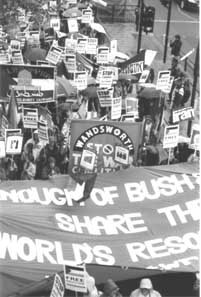
THOUSANDS of friends and supporters of Palestine braved the wet and windy weather last Saturday to march from the Thames Embankment, via Parliament Square, to Trafalgar Square for a rally calling for an end to the illegal Israeli occupation of the Palestinian homeland. The event was organised by the Palestine Solidarity Campaign, Association of Palestinian Community, Palestinian Return Centre, British Muslim Initiative, Friends of Al-Aqsa and the Palestinian Forum in Britain.
It was supported by: Just Peace UK, Muslim Association of Britain, Jews for Justice for Palestinians, Pax Christi, Stop the War Coalition, Campaign for Freedom and Justice for Samar and Jawad, War on Want, Arab Media Watch and major British trade unions. These included public sector union Unison, the National Union of Journalists and the lecturers’ union Natfhe.
Placards and banners on the march demanded: “Stop starving Palestinians” – a reference to the current Israeli economic blockade of Palestine – and called for justice for the Palestinian people.
Professor Manual Assassian, the man who would be the Palestinian ambassador to Britain if Palestine was recognised as a country, addressed the rally. He said that 70 percent of Palestinians were living below the poverty line in a totally gloomy, desperate, desolate and unpredictable environment. The western world preaches democracy and the rule of law but when the Palestinians practice democracy, it reneges.
Other speakers included Green Party MEP Caroline Lucas – who called on the British government to reject Israel’s illegal and immoral occupation – and Baroness Jenny Tonge.
Labour MP Jeremy Corbyn told the rally: “We are here today because we believe that peace can only come about through justice for the Palestinian people. Wars like the wars in Afghanistan and Iraq and occupations only benefit those who sell arms.
“The losers are the dispossessed in the Middle East region. Peace will not come about through another insane conflict against the people of Iran. Peace and security will only come through recognising the rights of others on the planet.”
The demonstrators were also addressed by speakers from the Palestine Solidarity Campaign, the Palestinian Forum in Britain, the Palestinian Community in Britain, Friends of Al Aqsa and Jews for Justice for Palestine.
Saturday, May 20, 2006
Railway workers take pensions fight to Parliament
SO MANY rail workers turned up at last Tuesday’s (9th May) lobby of Parliament – in defence of workers’ pensions – that the rally had to be divided into two committee rooms at the Palace of Westminster.
The lobby was organised jointly by rail unions to demand Government pressure on the privatised rail companies to negotiate with the unions over the future of the industry’s pension schemes.
The speakers at the rally – Francis O’Grady from the TUC, Keith Norman, general secretary of the train drivers’ union Aslef, Bob Crow of the RMT, Gerry Doherty of TSSA and John Wall (Amicus) – scurried from room to room to get the pensions message over.
Keith Norman condemned the Government for failing to offer any help in solving the burning issue of pensions in the rail industry. urgency
“The rail unions jointly went to the Department for Transport to stress the urgency of the situation, to talk about the probability of industrial action and to urge the Government to broker peace talks between the national unions and representatives of the franchised companies. They failed to do this,” he told the rally.
“They told us to go and talk to the companies individually – all 100 plus! And at the same time the minister says he hopes we can all come to an agreement.
“How can we come to an agreement if we have no one to talk to? The job of Government is to arrange a forum for national talks – and it has refused to move a muscle.
“This is a decision it will regret.”
The unions were contemptuous of the Government excuse that it could do nothing because since privatisation the individual companies were independent and out of its control. control
Gerry Doherty pointed out that the Government now hands out £4 billion to train companies every year. “How can anyone control a purse of £4 billion and not have any influence?” he demanded.
“When our industry was nationalised the taxpayer subsidised the industry by £1 billion. Since privatisation the subsidies have gone to £4 billion,” he added.
“Can you imagine the outcry in the media if those figures were the other way round and nationalisation was shown to cost four times as much as privatisation?”
There seems little chance that industrial action over the issue will be averted. The RMT and TSSA announced at the lobby that they will commence ballots within all companies before the end of May.
The lobby was organised jointly by rail unions to demand Government pressure on the privatised rail companies to negotiate with the unions over the future of the industry’s pension schemes.
The speakers at the rally – Francis O’Grady from the TUC, Keith Norman, general secretary of the train drivers’ union Aslef, Bob Crow of the RMT, Gerry Doherty of TSSA and John Wall (Amicus) – scurried from room to room to get the pensions message over.
Keith Norman condemned the Government for failing to offer any help in solving the burning issue of pensions in the rail industry. urgency
“The rail unions jointly went to the Department for Transport to stress the urgency of the situation, to talk about the probability of industrial action and to urge the Government to broker peace talks between the national unions and representatives of the franchised companies. They failed to do this,” he told the rally.
“They told us to go and talk to the companies individually – all 100 plus! And at the same time the minister says he hopes we can all come to an agreement.
“How can we come to an agreement if we have no one to talk to? The job of Government is to arrange a forum for national talks – and it has refused to move a muscle.
“This is a decision it will regret.”
The unions were contemptuous of the Government excuse that it could do nothing because since privatisation the individual companies were independent and out of its control. control
Gerry Doherty pointed out that the Government now hands out £4 billion to train companies every year. “How can anyone control a purse of £4 billion and not have any influence?” he demanded.
“When our industry was nationalised the taxpayer subsidised the industry by £1 billion. Since privatisation the subsidies have gone to £4 billion,” he added.
“Can you imagine the outcry in the media if those figures were the other way round and nationalisation was shown to cost four times as much as privatisation?”
There seems little chance that industrial action over the issue will be averted. The RMT and TSSA announced at the lobby that they will commence ballots within all companies before the end of May.
Nurses rally against the cuts!
by Caroline Colebrook
HUNDREDS of nurses from all over England rallied in Westminster last Thursday to tell their MPs of their concerns about the impact of NHS deficits on patient services and nursing jobs.
They were joined by nurses, midwives, porters, cleaners, occupational therapists, cooks and administrative staff in an event organised by the Royal College of Nursing and the giant public sector union Unison to protest at the effect of the closures on patient care and staff morale.
They also attended a rally on the impact of NHS deficits at Westminster Central Hall.
RCN General Secretary Dr Beverly Malone, spoke at the event and expressed her concern about the impact of NHS deficits on patient care and nursing jobs, saying: “Today we can defend our patients by lobbying our politicians. Today, we have an opportunity to make our case and offer our solutions. Today we have the chance to say with a voice that is dignified as well as determined, professional as well as passionate: keep nurses working and keep patients safe.
“We recognise that massive sums have been invested and huge strides have been made in improving the NHS in recent years. We also believe that we’ve come too far and achieved too much to sacrifice it because of deficits.
“That’s why the RCN is saying this is not the time to leave trusts to sink or swim, this is the time for support and solutions, this is the time to put high quality patient care back at the top of the health agenda, this is the time to work together to tackle the deficits crisis.”
The protest came as the health unions prepared for crisis talks with Health Secretary Patricia Hewitt next week – in a bid to slow down the Government’s damaging reforms.
Arriving at the House of Commons in an open top bus, health workers first lobbied outside the building, before attending a meeting with MPs inside.
“We want to show MPs the faces behind the figures,” said Unison head of health Karen Jennings.
“Last week’s local election results sent a clear message that the public are not happy with the direction the Government is taking. It’s time to listen and stop the constant revolution destabilising our NHS, stop featherbedding the private sector and keep the NHS working.”
Speakers at the meeting included Karen Jennings, TUC deputy general secretary Frances O’Grady, and Labour MP and former health secretary Frank Dobson.
The Queen Elizabeth Hospital in Woolwich is typical of hospitals facing a debt crisis and having to make cuts that will have a “devastating impact” on patient care.
The trust has already drawn up an £11 million savings plan and is waiting to hear from a new regional health authority whether it will be forced to make a further £6.4 million cuts.
The Government says that hospitals must break even by the end of March next year and it seems the Queen Elizabeth will still be £6.4 million in debt by then.
The trust’s total budget if £140 million but £15 million a year of this has to be paid into the PFI scheme that rebuilt the hospital.
The trust is seeking to become a foundation hospital but local campaigners are opposing this.
Frances Hook of Keep Our NHS said that the trend towards foundation trusts is evidence of the NHS becoming a corporate machine.
“The Government rhetoric is that foundation status will give communities more control over their hospital.
“In reality foundation hospitals will be given unlimited powers to enter into joint ventures with the private sector.
“The drive for profit will erode patient care and create competition between hospitals.”
Meanwhile an investigation by Hospital Doctor magazine revealed that NHS managers are offering “bribes” to general practitioners to persuade them to send patients to a private treatment centre instead of local NHS hospitals.
The investigation uncovered unorthodox payments of £30 for every patient sent to the private sector Greater Manchester surgical centre, run by the South African operator Netcare.
HUNDREDS of nurses from all over England rallied in Westminster last Thursday to tell their MPs of their concerns about the impact of NHS deficits on patient services and nursing jobs.
They were joined by nurses, midwives, porters, cleaners, occupational therapists, cooks and administrative staff in an event organised by the Royal College of Nursing and the giant public sector union Unison to protest at the effect of the closures on patient care and staff morale.
They also attended a rally on the impact of NHS deficits at Westminster Central Hall.
RCN General Secretary Dr Beverly Malone, spoke at the event and expressed her concern about the impact of NHS deficits on patient care and nursing jobs, saying: “Today we can defend our patients by lobbying our politicians. Today, we have an opportunity to make our case and offer our solutions. Today we have the chance to say with a voice that is dignified as well as determined, professional as well as passionate: keep nurses working and keep patients safe.
“We recognise that massive sums have been invested and huge strides have been made in improving the NHS in recent years. We also believe that we’ve come too far and achieved too much to sacrifice it because of deficits.
“That’s why the RCN is saying this is not the time to leave trusts to sink or swim, this is the time for support and solutions, this is the time to put high quality patient care back at the top of the health agenda, this is the time to work together to tackle the deficits crisis.”
The protest came as the health unions prepared for crisis talks with Health Secretary Patricia Hewitt next week – in a bid to slow down the Government’s damaging reforms.
Arriving at the House of Commons in an open top bus, health workers first lobbied outside the building, before attending a meeting with MPs inside.
“We want to show MPs the faces behind the figures,” said Unison head of health Karen Jennings.
“Last week’s local election results sent a clear message that the public are not happy with the direction the Government is taking. It’s time to listen and stop the constant revolution destabilising our NHS, stop featherbedding the private sector and keep the NHS working.”
Speakers at the meeting included Karen Jennings, TUC deputy general secretary Frances O’Grady, and Labour MP and former health secretary Frank Dobson.
The Queen Elizabeth Hospital in Woolwich is typical of hospitals facing a debt crisis and having to make cuts that will have a “devastating impact” on patient care.
The trust has already drawn up an £11 million savings plan and is waiting to hear from a new regional health authority whether it will be forced to make a further £6.4 million cuts.
The Government says that hospitals must break even by the end of March next year and it seems the Queen Elizabeth will still be £6.4 million in debt by then.
The trust’s total budget if £140 million but £15 million a year of this has to be paid into the PFI scheme that rebuilt the hospital.
The trust is seeking to become a foundation hospital but local campaigners are opposing this.
Frances Hook of Keep Our NHS said that the trend towards foundation trusts is evidence of the NHS becoming a corporate machine.
“The Government rhetoric is that foundation status will give communities more control over their hospital.
“In reality foundation hospitals will be given unlimited powers to enter into joint ventures with the private sector.
“The drive for profit will erode patient care and create competition between hospitals.”
Meanwhile an investigation by Hospital Doctor magazine revealed that NHS managers are offering “bribes” to general practitioners to persuade them to send patients to a private treatment centre instead of local NHS hospitals.
The investigation uncovered unorthodox payments of £30 for every patient sent to the private sector Greater Manchester surgical centre, run by the South African operator Netcare.
Rapturous welcome for Chavez
HUGO CHAVEZ, the left-wing President of Venezuela, visited London last weekend as the guest of London Mayor Ken Livingstone, where he delivered a three-and-a-half-hour speech to a packed Camden Centre, attended meetings with trade union leaders and businessmen and gave lots of press interviews. But he did not meet Prime Minister Tony Blair.
The main message he delivered loud and clear was: “We have to marshal our ideas for a better world. We have to infect people. Let’s have a badge saying, ‘I’m a socialist. I will infect you’.”
He received a rapturous welcome from working class, left and progressive organisations and individuals on the strength of his courageous stand against US imperialism and his use of revenues from Venezuela’s vast oil reserves to raise living standards, education and healthcare for Venezuela’s working class – in defiance of the imperialists who think it their right to exploit all the world’s oil for their own profit.
Chavez spoke of his childhood and the effects of extreme poverty on Venezuelan children. He recalled a friend called Jorge he played ball with every day. “Then one day, he didn’t come to school. We asked why. They told us his mother had died in childbirth.
“This happened a lot because there were no doctors for anyone.” Jorge’s father had also died so “he was forced to go to work and become a child labourer. He had little brothers and sisters and they had to be fed”.
Then Chavez spoke of his own family: “Yes, I saw the pain of poverty. My little brother was called Enso, he was a very beautiful child but he became ill. I remember him lying in a hammock.
“He was always smiling. But he died. There were no doctors, nothing. We buried him in a bag. He was one of those children who are swallowed by poverty.”
This poverty existed alongside immense wealth brought by the oil.
During his army career Chavez found himself fighting Maoist rebels and realised they were the same class as himself. He began to study politics. That was the beginning of his journey to becoming what US Secretary of State Condoleezza Rice describes as “the most dangerous man in the region”.
Labour MP Jeremy Corbyn, who shared a platform with him at the Camden Centre, said: “I am very interested in what they are doing in Venezuela in terms of lessening the gap between rich and poor.
“Maybe the British government could learn something from that. Blair and the Government should recognise which way the wind is blowing in Latin America.”
success
Indeed Chavez’s success in gaining and retaining power – despite an attempted coup against him and numerous imperialist efforts to destabilise his government – that a succession of other Latin American countries have returned left-wing governments. These include Evo Morales in Bolivia and Ollanta Hulama in Peru. Others like Manuel Lopez Obrador in Mexico and veteran socialist fighter Daniel Ortega in Nicaragua seem likely to come to power soon.
Chavez is setting the example that is giving the working peoples of Latin America real hope and courage to defy American imperialism. He is also giving practical help with cheap oil for progressive causes – including helping the poor people of the United States itself.
Speaking about the US, Chavez told the London rally that Washington was “the greatest threat to this planet” and continued: “The final hours of empire have arrived. Now we have to say to the empire, ‘We are not afraid of you, you are a paper tiger’.” And he added that US imperialism was as doomed as a pig on its way to the slaughterhouse.
The main message he delivered loud and clear was: “We have to marshal our ideas for a better world. We have to infect people. Let’s have a badge saying, ‘I’m a socialist. I will infect you’.”
He received a rapturous welcome from working class, left and progressive organisations and individuals on the strength of his courageous stand against US imperialism and his use of revenues from Venezuela’s vast oil reserves to raise living standards, education and healthcare for Venezuela’s working class – in defiance of the imperialists who think it their right to exploit all the world’s oil for their own profit.
Chavez spoke of his childhood and the effects of extreme poverty on Venezuelan children. He recalled a friend called Jorge he played ball with every day. “Then one day, he didn’t come to school. We asked why. They told us his mother had died in childbirth.
“This happened a lot because there were no doctors for anyone.” Jorge’s father had also died so “he was forced to go to work and become a child labourer. He had little brothers and sisters and they had to be fed”.
Then Chavez spoke of his own family: “Yes, I saw the pain of poverty. My little brother was called Enso, he was a very beautiful child but he became ill. I remember him lying in a hammock.
“He was always smiling. But he died. There were no doctors, nothing. We buried him in a bag. He was one of those children who are swallowed by poverty.”
This poverty existed alongside immense wealth brought by the oil.
During his army career Chavez found himself fighting Maoist rebels and realised they were the same class as himself. He began to study politics. That was the beginning of his journey to becoming what US Secretary of State Condoleezza Rice describes as “the most dangerous man in the region”.
Labour MP Jeremy Corbyn, who shared a platform with him at the Camden Centre, said: “I am very interested in what they are doing in Venezuela in terms of lessening the gap between rich and poor.
“Maybe the British government could learn something from that. Blair and the Government should recognise which way the wind is blowing in Latin America.”
success
Indeed Chavez’s success in gaining and retaining power – despite an attempted coup against him and numerous imperialist efforts to destabilise his government – that a succession of other Latin American countries have returned left-wing governments. These include Evo Morales in Bolivia and Ollanta Hulama in Peru. Others like Manuel Lopez Obrador in Mexico and veteran socialist fighter Daniel Ortega in Nicaragua seem likely to come to power soon.
Chavez is setting the example that is giving the working peoples of Latin America real hope and courage to defy American imperialism. He is also giving practical help with cheap oil for progressive causes – including helping the poor people of the United States itself.
Speaking about the US, Chavez told the London rally that Washington was “the greatest threat to this planet” and continued: “The final hours of empire have arrived. Now we have to say to the empire, ‘We are not afraid of you, you are a paper tiger’.” And he added that US imperialism was as doomed as a pig on its way to the slaughterhouse.
Monday, May 15, 2006
KICK BLAIR OUT!
LAST WEEK’S local election results are the writing on the wall for Tony Blair and those who cling to his coat-tails. Rocked by incompetence, scandal and sleaze the Government looks as if it’s on its last legs with the latest opinion polls showing that Labour’s support has fallen to its lowest level since 1992.
Labour lost over 300 council seats in the English local elections and control of 19 councils, including a number of key boroughs in London, mostly to a resurgent Tory Party with the Liberal Democrats making only modest gains. To cap it all, Labour suffered a humiliating reverse in Barking and Dagenham, with 11 councillors defeated by the neo-Nazi BNP and failed to stem the advance of George Galloway’s Respect Party in Tower Hamlets.
The blame game began while the gloomy results were being tallied. Some believe that Blair’s spin merchants were deliberately puffing up the BNP in the run-up to the poll to divert attention away from the expected swing to the Tories.
There can be no doubt that the widely-publicised remarks by Barking Labour MP Margaret Hodge, who claimed that 80 per cent of white families in her constituency were “tempted” by the BNP, gave the fascists the oxygen to fuel their racist campaign. But that doesn’t fully explain why a thoroughly working-class borough that was once a Labour stronghold with a thriving local communist movement 30 years ago should become the feeding ground for the racists and fascists.
Labour’s traditional working class supporters are deeply disillusioned. They put Blair in office three times on the bounce and have got little in return. A tiny minority have been duped by the lies of the fascists who blame the woes of the workers on the immigrants and the ethnic minorities and seek to solve the crisis by simply redistributing the crumbs from the rich man’s table. Others fall for the old lies of bourgeois Tory and Liberal Democrat parties who have never served the working class and can never defend our class’s interests.
For those who think the answer is to build another left social-democratic movement in opposition to Labour, the paltry gains of Respect and the former Trotskyist parties of the left are a warning. The only alternative to a Labour Government at the next election is going to be one led by the Tories – and we only have to recall the dark days of Mrs Thatcher and John Major to know exactly what that will mean for the working class.
Blair’s answer was a pathetic reshuffle but if he thinks that sacking Charles Clarke and demoting Jack Straw will take the heat off him he is much mistaken.
Labour’s problems begin and end with Blair and his “New Labour” agenda that is becoming increasingly indistinguishable from the worst excesses of the Thatcher era. Blair and his cronies bleat on that they listen to the people when it is obvious to everyone apart from themselves that the Labour leadership only head the advice of the most venal and reactionary elements of the global ruling class.
They took us into the criminal invasion and occupation of Iraq reducing our soldiers to the role of sepoys in the service of American imperialism. While our health service totters for lack of funds, billions are spent on the armed forces and the so-called nuclear deterrent that is ultimately under American control.
The masses want affordable housing, decent jobs, and adequate pensions for a dignified retirement that a country like Britain, with the fourth greatest economy in the world, can easily provide. What we’ve got is round the clock drinking, casinos and a minimal tax system that has made our country a paradise for the millionaires.
Blair says he’s going but he still won’t name the day. We have to make sure it’s as soon as possible. Blair’s an albatross around Labour’s neck. The longer he stays the worse it will get. A leadership election must be triggered under Labour Party rules to force him out. The sooner he goes the better.
Labour lost over 300 council seats in the English local elections and control of 19 councils, including a number of key boroughs in London, mostly to a resurgent Tory Party with the Liberal Democrats making only modest gains. To cap it all, Labour suffered a humiliating reverse in Barking and Dagenham, with 11 councillors defeated by the neo-Nazi BNP and failed to stem the advance of George Galloway’s Respect Party in Tower Hamlets.
The blame game began while the gloomy results were being tallied. Some believe that Blair’s spin merchants were deliberately puffing up the BNP in the run-up to the poll to divert attention away from the expected swing to the Tories.
There can be no doubt that the widely-publicised remarks by Barking Labour MP Margaret Hodge, who claimed that 80 per cent of white families in her constituency were “tempted” by the BNP, gave the fascists the oxygen to fuel their racist campaign. But that doesn’t fully explain why a thoroughly working-class borough that was once a Labour stronghold with a thriving local communist movement 30 years ago should become the feeding ground for the racists and fascists.
Labour’s traditional working class supporters are deeply disillusioned. They put Blair in office three times on the bounce and have got little in return. A tiny minority have been duped by the lies of the fascists who blame the woes of the workers on the immigrants and the ethnic minorities and seek to solve the crisis by simply redistributing the crumbs from the rich man’s table. Others fall for the old lies of bourgeois Tory and Liberal Democrat parties who have never served the working class and can never defend our class’s interests.
For those who think the answer is to build another left social-democratic movement in opposition to Labour, the paltry gains of Respect and the former Trotskyist parties of the left are a warning. The only alternative to a Labour Government at the next election is going to be one led by the Tories – and we only have to recall the dark days of Mrs Thatcher and John Major to know exactly what that will mean for the working class.
Blair’s answer was a pathetic reshuffle but if he thinks that sacking Charles Clarke and demoting Jack Straw will take the heat off him he is much mistaken.
Labour’s problems begin and end with Blair and his “New Labour” agenda that is becoming increasingly indistinguishable from the worst excesses of the Thatcher era. Blair and his cronies bleat on that they listen to the people when it is obvious to everyone apart from themselves that the Labour leadership only head the advice of the most venal and reactionary elements of the global ruling class.
They took us into the criminal invasion and occupation of Iraq reducing our soldiers to the role of sepoys in the service of American imperialism. While our health service totters for lack of funds, billions are spent on the armed forces and the so-called nuclear deterrent that is ultimately under American control.
The masses want affordable housing, decent jobs, and adequate pensions for a dignified retirement that a country like Britain, with the fourth greatest economy in the world, can easily provide. What we’ve got is round the clock drinking, casinos and a minimal tax system that has made our country a paradise for the millionaires.
Blair says he’s going but he still won’t name the day. We have to make sure it’s as soon as possible. Blair’s an albatross around Labour’s neck. The longer he stays the worse it will get. A leadership election must be triggered under Labour Party rules to force him out. The sooner he goes the better.
BNP gain "disappointing"
ANTI-FASCIST campaigners should not be too downhearted after the neo-Nazi British National Party gained 32 new councillors in last Thursday’s local elections, leaving them with a total of 42 throughout the country.
Only one of their existing councillors, whose seat was up for re-election, held that seat. Elsewhere voters who had experienced life with a BNP councillor did not want to repeat the experience.
The largest BNP gain was in the London Borough of Barking and Dagenham (one subject to a High Court petition).
The anti-fascist magazine Searchlight said: “Any BNP victory should be a cause of concern. Its presence raises tensions and divides communities, and its lies, which are central to its campaigning tactics, incite fear and racial violence.
“While the media focused on the success in east London, BNP fortunes elsewhere were more mixed. Although the BNP took three seats in Stoke-on-Trent, Epping Forest and Sandwell, there were other areas where it failed to make its expected breakthrough.
“There were no BNP successes in Oldham, Dudley, Blackburn and Thurrock. The BNP fell back in Calderdale, where it was defending two seats but only succeeded in one. Kirklees was another top target and the two councillors elected there were fewer than expected.”
In Bradford the BNP gained only one new councillor compared to the four it gained in 2004, despite serious BNP threats in nine wards, it lost two of the wards it had won in 2004. The defeat of the BNP in these areas was down to serious grass roots hard work by anti-fascist campaigners, including the Searchlight organisation, local anti-BNP groups, political parties and trade unions.
Searchlight said: “The work done by a few activists across the country cannot be underestimated. Over 400,000 copies of the Searchlight newspaper, in 16 editions, were distributed as were 220,000 postcards.
“The Searchlight telephone banks identified 33,000 anti-BNP voters and it is clear that our direct contact with these people in several wards stopped the BNP from winning. Coseley East, Tipton Green and Longton North are just three examples. “The large increase in BNP councillors is discouraging but not altogether unexpected. The media’s coverage of the BNP was quite despicable, especially the BBC which at times appeared more like BNP TV.
“Then there was the Home Office’s debacle over the foreign prisoners issue, which unsurprisingly played straight into the hands of the BNP. The BNP will never get publicity like it again, especially in the run-up to an election, and with that in mind one could argue that if it could not break through in some places this year then it never will.”
The BNP gains in Barking and Dagenham came after remarks from local New Labour Margaret Hodge that eight out of ten of the constituents she spoke to “had considered” voting for the BNP. For this boost the BNP sent her a bunch of flowers.
The problem was exacerbated by the failure of other parties to stand. In many Barking and Dagenham wards, the only names on the ballot papers belonged to either Labour or the BNP. Protest votes against Labour had nowhere else to go.
“Barking and Dagenham was obviously the worst result of the night,” said Searchlight, “but no blame could be attached to the local Labour Party, unions or local anti-BNP activists. The quite ridiculous comments from Margaret Hodge, the MP for Barking, lit the fuse that ended with 12 BNP councillors elected.
“The media were never out of the area and they did more than the BNP themselves to spread the racist message and present the BNP as a legitimate protest vote.
“Against this backdrop, there was little anti-fascists could do. There is no disguising the BNP threat. Anti-fascists need to regroup and critically assess what have been their most effective campaigning techniques. The trade unions need to look again at how to prevent their members from supporting the BNP.
“All of the political parties need to look at how they can re-engage with voters rather than take them for granted. And there also needs to be serious consideration of wider public policy.
“How can local government be made more meaningful and important? How can we manage an increase in migrant workers without creating a backlash from those who see their jobs disappear as a consequence? Most fundamentally, how can we connect growing numbers of disillusioned people with the political system?
“Our task gets harder but the campaigns in Dudley, Oldham and Bradford prove that we can win even against the background of a media love-in with the BNP. The 2006 local elections were disappointing but the BNP did not achieve the political breakthrough some think it did.
“Our job is to make sure that it is downhill from now on for the BNP.”
Only one of their existing councillors, whose seat was up for re-election, held that seat. Elsewhere voters who had experienced life with a BNP councillor did not want to repeat the experience.
The largest BNP gain was in the London Borough of Barking and Dagenham (one subject to a High Court petition).
The anti-fascist magazine Searchlight said: “Any BNP victory should be a cause of concern. Its presence raises tensions and divides communities, and its lies, which are central to its campaigning tactics, incite fear and racial violence.
“While the media focused on the success in east London, BNP fortunes elsewhere were more mixed. Although the BNP took three seats in Stoke-on-Trent, Epping Forest and Sandwell, there were other areas where it failed to make its expected breakthrough.
“There were no BNP successes in Oldham, Dudley, Blackburn and Thurrock. The BNP fell back in Calderdale, where it was defending two seats but only succeeded in one. Kirklees was another top target and the two councillors elected there were fewer than expected.”
In Bradford the BNP gained only one new councillor compared to the four it gained in 2004, despite serious BNP threats in nine wards, it lost two of the wards it had won in 2004. The defeat of the BNP in these areas was down to serious grass roots hard work by anti-fascist campaigners, including the Searchlight organisation, local anti-BNP groups, political parties and trade unions.
Searchlight said: “The work done by a few activists across the country cannot be underestimated. Over 400,000 copies of the Searchlight newspaper, in 16 editions, were distributed as were 220,000 postcards.
“The Searchlight telephone banks identified 33,000 anti-BNP voters and it is clear that our direct contact with these people in several wards stopped the BNP from winning. Coseley East, Tipton Green and Longton North are just three examples. “The large increase in BNP councillors is discouraging but not altogether unexpected. The media’s coverage of the BNP was quite despicable, especially the BBC which at times appeared more like BNP TV.
“Then there was the Home Office’s debacle over the foreign prisoners issue, which unsurprisingly played straight into the hands of the BNP. The BNP will never get publicity like it again, especially in the run-up to an election, and with that in mind one could argue that if it could not break through in some places this year then it never will.”
The BNP gains in Barking and Dagenham came after remarks from local New Labour Margaret Hodge that eight out of ten of the constituents she spoke to “had considered” voting for the BNP. For this boost the BNP sent her a bunch of flowers.
The problem was exacerbated by the failure of other parties to stand. In many Barking and Dagenham wards, the only names on the ballot papers belonged to either Labour or the BNP. Protest votes against Labour had nowhere else to go.
“Barking and Dagenham was obviously the worst result of the night,” said Searchlight, “but no blame could be attached to the local Labour Party, unions or local anti-BNP activists. The quite ridiculous comments from Margaret Hodge, the MP for Barking, lit the fuse that ended with 12 BNP councillors elected.
“The media were never out of the area and they did more than the BNP themselves to spread the racist message and present the BNP as a legitimate protest vote.
“Against this backdrop, there was little anti-fascists could do. There is no disguising the BNP threat. Anti-fascists need to regroup and critically assess what have been their most effective campaigning techniques. The trade unions need to look again at how to prevent their members from supporting the BNP.
“All of the political parties need to look at how they can re-engage with voters rather than take them for granted. And there also needs to be serious consideration of wider public policy.
“How can local government be made more meaningful and important? How can we manage an increase in migrant workers without creating a backlash from those who see their jobs disappear as a consequence? Most fundamentally, how can we connect growing numbers of disillusioned people with the political system?
“Our task gets harder but the campaigns in Dudley, Oldham and Bradford prove that we can win even against the background of a media love-in with the BNP. The 2006 local elections were disappointing but the BNP did not achieve the political breakthrough some think it did.
“Our job is to make sure that it is downhill from now on for the BNP.”
Saturday, May 13, 2006
Irish Republicanism never been stronger
 Republicanism in Ireland ‘has never been stronger’
by Theo Russell
FORMER hunger striker Jackie McMullan last Saturday told a London meeting: “Republicanism in Ireland has never been stronger – it’s on the march. Men and women have come out of prison and re-joined the struggle, and the vast majority are still involved.”
He was talking to the annual James Connolly-Bobby Sands commemoration meeting, held this year at the London Irish Centre – in the year that marks the 90th anniversary of the Easter Rising, in which James Connolly played a leading role and was wounded, taken prisoner and shot by the British occupation forces.
This year also marks the 25th anniversary of the famous Long Kesh hunger strike, in which Bobby Sands and eight other prisoners gave their lives rather than be classed as common criminals for fighting to free the occupied six counties of the north of Ireland. During the strike Bobby Sands was elected as an MP to Westminster, though of course he was never able to take his seat.
Jackie McMullan reminded his audience that there were significant hunger strikes apart from at Long Kesh, in Portlaoise, Limerick and the Crumlin in Belfast, some involving force-feeding for over a year.
He recalled Bobby Sands saying that “what is won or lost in the prisons will be won for the republic,” and that “the British government is trying to turn the prisons into a breaker’s yard for republicanism.”
Jackie continued: “The struggle against criminalisation had become central to the republican movement. Their struggle and sacrifice has been imprinted on the history of our country like no other. It was a watershed event. British rule in Ireland was once again exposed as a criminal act.”
“The elections of Bobby Sands as MP and one of his close comrades as TD (Member of the Irish Parliament) sent shockwaves through the political establishment in Ireland.”
Jackie ended by saying: “Our objectives have still not been realised, and the need for solidarity still applies.” The meeting was organised by the Wolfe Tone Society and during a workshop on campaign work Dennis Grace listed the many areas of work the society had been involved with over the years.
These included:
• Working closely with left Labour MPs Jeremy Corbyn and John McDonnell;
• Regular (and highly appreciated) contact with republican prisoners, including those at Portlaoise, sending cards, books, music and DVDs;
• Playing a major part in campaigns for justice for Diarmuid O’Neill, the release of Roisin McAliskey, the Colombia Three, the Bloody Sunday campaign, the Holy Cross school, the Garvaghy Road, the Short Strand, opposing Orange Order marches and many other issues;
• Cultural events, including a commemoration of the United Irish Rising in songs and poems, a Cuban-Irish night and annual Dinner Dances;
• Fact-finding and solidarity visits to combat media distortion and disinformation, and a trip to London for children from the Short Strand including meeting an MP at Parliament and Mayor Ken Livingstone at City Hall.
• A regular campaign newsletter, Fuascailt, now available on the Wolfe Tone Society website;
• Solidarity with Cuba, Palestine and the Basque Country, and support for the Muslim community, the target of the new anti-terror laws.
Dennis said: “Realising peace and justice in Ireland requires people to actually do the necessary work,” and recalled that at Sinn Féin’s Ard Fheis last February Gerry Adams had spoken of “the huge debt of gratitude to solidarity in England”, making solidarity there one the party’s top five priorities.
He stressed the importance of actually writing to MPs, giving the example of John McDonnell being asked to raise an issue in Parliament when he hadn’t received a single letter about it.
Francis Brolly, Sinn Féin MLA (Member of the suspended Northern Ireland Assembly) for Limavady and well known singer and songwriter, said: “The 1966 commemoration of the Easter Rising in Dublin re-kindled a flame, especially in the north, but also provoked the fear and hatred of the Northern Ireland establishment and the British ruling class.
“Two years later men and women in the north took to the streets to protest against the humiliation which their mothers and fathers had endured.
“The IRA campaign was difficult and terrible, and people knew there would be a legacy which would be very difficult to deal with.
“The British establishment was shaken by the campaign, and came up with a plan to ‘get them in the prisons’ through the criminalisation campaign.”
Peter Middleton of the WTS ended the rally by speaking of the need to lobby the British government to re-vitalise the Northern Ireland Assembly, hold new elections, and to end its appeasement of the DUP, adding that “we need to re-focus our campaign on the whole of the 32 counties”.
Friday, May 12, 2006
Soviet Victory Day in London
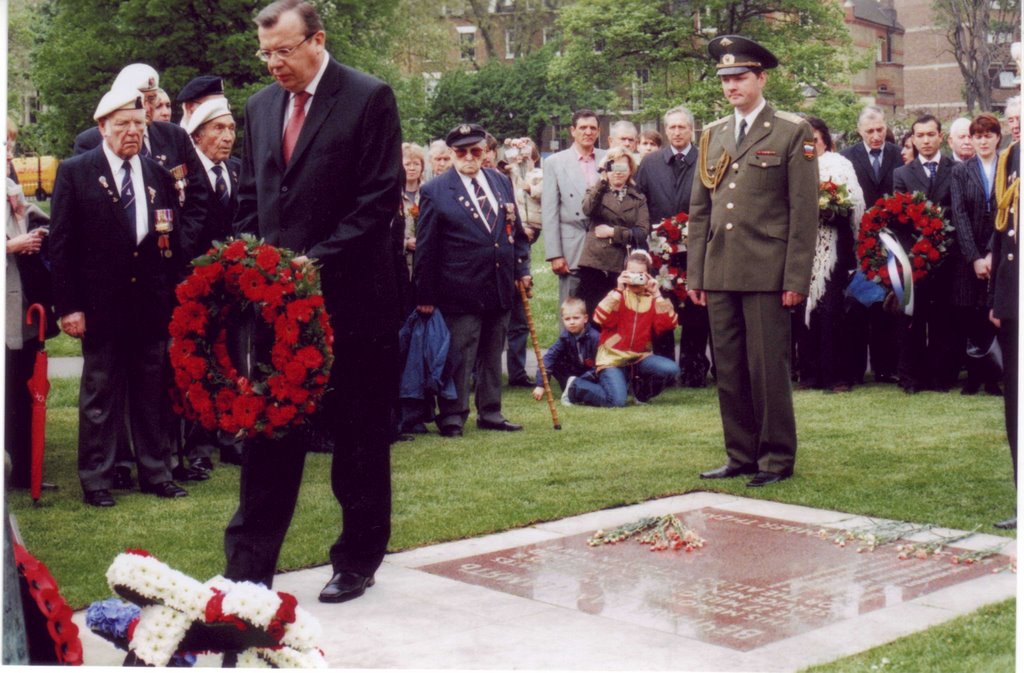 Soviet Victory Day
THE PEOPLES of the former Soviet Union still celebrate 9th May as Victory Day, the day that the Nazis surrendered in 1945. And in south London, at the Soviet War Memorial in the grounds of the Imperial War Museum, representatives of the former Soviet republics and war veterans gathered to remember the 27 million Soviet citizens who died in the war to defeat Nazism. There were also a number of local dignitaries and veterans’ organisations represented. The distinctive white berets of the Russian Convoy Club were, as ever, present in good numbers.
After brief speeches from Philip Matthews, who chairs the Soviet Memorial Trust Fund, from Tom Watson, the newly appointed Minister for Veterans on behalf of the Government and from HE Yuri Fedotov, the Ambassador of the Russian Federation.
Then followed a wreath laying ceremony, with flowers laid by the ambassadors of Russia, Armenia, Belarus, Georgia, Kazakhstan, Moldova, Kyrgyzstan, Turkmenistan and Uzbekistan.
Representatives of the Australian and United States embassies also laid wreaths, as did Bob Wareing MP, a veteran representative of London Region Ucatt, Keith Bell of the Russian Convoy Club and Jean Turner of the Society for Cooperation in Russian and Soviet Studies.
Also present were Squadron Leader FA Forbes and FV Bashford of the RAF in Russia Association.
After the ceremony, inside the museum’s cinema, Air Chief Marshall Sir John Cheshire presented a film, Hurricanes over Russia, which related a little-known piece of RAF history – the short but significant and successful existence of No 151 Wing.
After the German invasion of the Soviet Union on 22nd June 1941, Stalin’s call to Churchill for assistance was answered. Churchill replied positively, saying the British government was considering basing some British fighter squadrons in Murmansk.
In August 1941 the first Arctic Convoy carried 550 RAF men with Hurricane fighter aircraft on board in crates. Other Hurricanes were flown directly from warships to an airfield near Murmansk.
When all the planes had been assembled and gathered they comprised 151 Wing, which was in action against the Luftwaffe and engaged in training Russian pilots to fly Hurricanes, so that they could make the best use of the thousands of Hurricanes that would eventually be delivered as part of British aid to the Soviet war effort.
Friday, May 05, 2006
Organisation is the key!
The May Day March that made its way from outside Marx House on Clerkenwell Green to Trafalgar Square last Monday was the largest for decades and showed that Britain’s trade union movement can still turn out thousands when it has a mind to.
Here was the real British working class united and in upbeat mood to fight to defend pensions, education and the NHS; to oppose privatisation and to demand backing for a new Bill of Workers’ Rights. It was a far cry from the image of ignorant, apathetic racists that much of the media – and some Blairite Labour MPs – regard the working class to be. There were also plenty of colourful international contingents on the march as usual; reminding us that in celebrating May Day we are part of a global movement supported by billions.
As one speaker in Trafalgar Square put it, “How can we hope to win against people like Bush and Blair? We’ve only got six billion on our side!”
Organisation is the key. The power and strength of millions of workers can only be effective through unity and organisation. In 1848 the Chartist leader Ernest Jones told a rally in Manchester: “Some tell you that teetotalism will get you the Charter: The Charter don’t lie at the bottom of a glass of water. Some tell you social cooperation will do it; cooperation is at the mercy of those who hold political power. Then what will do it? Two year ago and more, I went to prison for speaking three words. Those words were: ‘Organise – organise – organise’… And this day again I say: ‘Organise! Organise! Organise!’”
Organisation is power and the ruling class know that once the working class is properly organised, they are doomed. That is why ever since the Chartist days they have sought to destroy and undermine working class organisation. They have sent splitters into our movement to foster faint-heartedness, reformism, revisionism, confusion and ultra-leftism.
The front line of the class struggle is inside the labour and trade union movement because the ruling class know that spreading disorganisation here is the key to them holding on to power.
The Labour Party was founded to be the political expression of the trade unions, the organised working class. And the ruling class set out to subvert it from the beginning. The correct strategy of the working class must be to combat that subversion and throw out the treacherous Blairites. But that cannot be done by quitting the arena of struggle. That is to surrender the labour movement to the enemy.
One small group calling themselves communists were calling on the unions to “Break the link with Labour! Defy the anti-trade union laws!” Nothing would suit ruling class better than to have the potential power of organised working class further fractured and splintered. Break the link with Labour and the movement will be fragmented and working class unity virtually impossible to achieve.
We owe it to our predecessors from the Chartists onwards, who struggled to build the labour movement we have today – and to the rank and file trade unionists and Labour Party members who are still working hard to save the party from a catastrophe in the local elections and keep the BNP at bay – to defend the unity and strength of the movement.
The current spate of scandals surrounding John Prescott and Charles Clarke – not to forget Tessa Jowell and the cash for coronets scam – have brought disgrace on the Labour leadership. The privatisation policies of Patricia Hewitt and Ruth Kelly are an attack on the working class. But all of them put together pale into insignificance compared to Blair taking the country into an illegal war on false pretences.
The trade union and labour movement leaders throughout the country must be aware that the leadership of their party is in the hands of the class enemy – and that they have the power and the organisational tools to throw out Blair and his clique. The rank and file have made their feelings clear on May Day. By the time you read this, it is likely that voters throughout the country will have made their views clear. The labour movement must use that power and deliver the movement from Blairism.
Here was the real British working class united and in upbeat mood to fight to defend pensions, education and the NHS; to oppose privatisation and to demand backing for a new Bill of Workers’ Rights. It was a far cry from the image of ignorant, apathetic racists that much of the media – and some Blairite Labour MPs – regard the working class to be. There were also plenty of colourful international contingents on the march as usual; reminding us that in celebrating May Day we are part of a global movement supported by billions.
As one speaker in Trafalgar Square put it, “How can we hope to win against people like Bush and Blair? We’ve only got six billion on our side!”
Organisation is the key. The power and strength of millions of workers can only be effective through unity and organisation. In 1848 the Chartist leader Ernest Jones told a rally in Manchester: “Some tell you that teetotalism will get you the Charter: The Charter don’t lie at the bottom of a glass of water. Some tell you social cooperation will do it; cooperation is at the mercy of those who hold political power. Then what will do it? Two year ago and more, I went to prison for speaking three words. Those words were: ‘Organise – organise – organise’… And this day again I say: ‘Organise! Organise! Organise!’”
Organisation is power and the ruling class know that once the working class is properly organised, they are doomed. That is why ever since the Chartist days they have sought to destroy and undermine working class organisation. They have sent splitters into our movement to foster faint-heartedness, reformism, revisionism, confusion and ultra-leftism.
The front line of the class struggle is inside the labour and trade union movement because the ruling class know that spreading disorganisation here is the key to them holding on to power.
The Labour Party was founded to be the political expression of the trade unions, the organised working class. And the ruling class set out to subvert it from the beginning. The correct strategy of the working class must be to combat that subversion and throw out the treacherous Blairites. But that cannot be done by quitting the arena of struggle. That is to surrender the labour movement to the enemy.
One small group calling themselves communists were calling on the unions to “Break the link with Labour! Defy the anti-trade union laws!” Nothing would suit ruling class better than to have the potential power of organised working class further fractured and splintered. Break the link with Labour and the movement will be fragmented and working class unity virtually impossible to achieve.
We owe it to our predecessors from the Chartists onwards, who struggled to build the labour movement we have today – and to the rank and file trade unionists and Labour Party members who are still working hard to save the party from a catastrophe in the local elections and keep the BNP at bay – to defend the unity and strength of the movement.
The current spate of scandals surrounding John Prescott and Charles Clarke – not to forget Tessa Jowell and the cash for coronets scam – have brought disgrace on the Labour leadership. The privatisation policies of Patricia Hewitt and Ruth Kelly are an attack on the working class. But all of them put together pale into insignificance compared to Blair taking the country into an illegal war on false pretences.
The trade union and labour movement leaders throughout the country must be aware that the leadership of their party is in the hands of the class enemy – and that they have the power and the organisational tools to throw out Blair and his clique. The rank and file have made their feelings clear on May Day. By the time you read this, it is likely that voters throughout the country will have made their views clear. The labour movement must use that power and deliver the movement from Blairism.
Biggest London May Day march for years
OVER 10,000 trade unionists last Monday took to the streets of London to mark International Workers Day and to give their backing for a new Campaign for Workplace Justice and a Bill for workers’ rights.
But the contingent from the RMT transport union alone was well over 1,000. The Transport and General Workers’ Union and Amicus also had huge contingents.
Other unions present included public sector union Unison, the Communication Workers’ Union, the GMB general union, building workers’ union Ucatt, train drivers’ union Aslef, the National Union of Journalists, broadcasting union Bectu, shopworkers’ union Usdaw, PCS civil service union, the National Union of Teachers and many more. There was hardly a union not represented.
There were banners, placards, flags and balloons. And there were jazz bands, brass bands, Punjabi drummers, and a lone bagpiper.
Dozens of trades councils were present, along with pensioners’ groups, an assortment of left wing parties and many international contingents. These included the colourful Turkish and Kurdish community groups and even a group from Bolivia.
The Gate Gourmet workers were there in force, along with the workers from Peugeot’s Ryton works, threatened with closure and the loss of 2,300 jobs.
Veteran trade union leader and International Brigader Jack Jones stood near the entrance to Trafalgar Square to welcome the marchers as they entered.
In the Square his successor, the TGWU general secretary Tony Woodley, spoke of the new initiative against the Thatcherite anti-union laws and for justice in the workplace. He said: “Solidarity must be put back at the centre of trade union and Labour Party policies.”
He called on the Government to heed the support of many MPs and millions of working people for the Trade Union Freedom Bill, which would allow trade unionists to take solidarity action in certain circumstances, and is supported by Labour Party conference policy.
The Bill would also remove restrictive procedures for ballots and notice of industrial action, and help develop justice at work for those whose rights were stripped away by successive Tory anti-union laws.
“Labour voted against each of those laws when in Opposition,” said Tony Woodley. “Surely it is not too much to expect the Government to recognise the need to restore fairness in the workplace through the measures contained in the Trade Union Freedom Bill.”
While no law could deliver fairness at work without the vigilance of trade unions to enforce it, the time had come to restore some equilibrium in industrial relations in Britain. needed now
“Strong trade unions are needed now more than ever to secure proper rights for all workers in safe workplaces. There are those who say that trade unions are old-fashioned and their concerns have been overtaken by the freedoms of the marketplace in labour and services,” he added.
“Don’t bother trying to explain that to the hundreds of workers killed each year because of unsafe working environments, or to the 150,000 seriously injured, often as a direct result of the criminal indifference of those who employ them. “The freedom of the market place is little consolation to the families of 23 Chinese migrant workers sacrificed on Morecambe Sands last year to the wickedness of exploitation which has gone on for so long in the farming and food industry.
“And freedom of employers to sack workers by text, by megaphone and by bullying also underlines the vital job which trade unions have to play in fighting for basic rights in employment.
“A series of vicious anti-union laws introduced by the Tories violated the concept of fairness at work, and we have waited more than long enough to restore equilibrium in industrial relations.
“Our demands are many, and I make no apology for that. But our basic requirement on behalf of all workers – and particularly the underpaid and exploited – is a decent living and a proper balance between working hours and family life.” Amicus general secretary Derek Simpson warned the Labour leadership that they face a “disastrous defeat” at the next general election unless the Government urgently addressed concerns over NHS cuts, job insecurities and pensions.
He called for a change in the Labour leadership to stop the rapid decline in support for the party. Simpson told the rally: “The sooner this Government learns some humility, starts listening to ordinary people, does something about employment laws, does something about pensions, does something to protect industry, then this demonstration would have served its purpose.”
TUC general secretary Brendan Barber told the rally strong laws were needed to end poverty pay, close the gender wage gap and tackle discrimination.
“No longer should British workers like the Peugeot workers in Coventry find that they are the cheapest and easiest in Europe to get rid of when the going gets tough,” he said.
But the contingent from the RMT transport union alone was well over 1,000. The Transport and General Workers’ Union and Amicus also had huge contingents.
Other unions present included public sector union Unison, the Communication Workers’ Union, the GMB general union, building workers’ union Ucatt, train drivers’ union Aslef, the National Union of Journalists, broadcasting union Bectu, shopworkers’ union Usdaw, PCS civil service union, the National Union of Teachers and many more. There was hardly a union not represented.
There were banners, placards, flags and balloons. And there were jazz bands, brass bands, Punjabi drummers, and a lone bagpiper.
Dozens of trades councils were present, along with pensioners’ groups, an assortment of left wing parties and many international contingents. These included the colourful Turkish and Kurdish community groups and even a group from Bolivia.
The Gate Gourmet workers were there in force, along with the workers from Peugeot’s Ryton works, threatened with closure and the loss of 2,300 jobs.
Veteran trade union leader and International Brigader Jack Jones stood near the entrance to Trafalgar Square to welcome the marchers as they entered.
In the Square his successor, the TGWU general secretary Tony Woodley, spoke of the new initiative against the Thatcherite anti-union laws and for justice in the workplace. He said: “Solidarity must be put back at the centre of trade union and Labour Party policies.”
He called on the Government to heed the support of many MPs and millions of working people for the Trade Union Freedom Bill, which would allow trade unionists to take solidarity action in certain circumstances, and is supported by Labour Party conference policy.
The Bill would also remove restrictive procedures for ballots and notice of industrial action, and help develop justice at work for those whose rights were stripped away by successive Tory anti-union laws.
“Labour voted against each of those laws when in Opposition,” said Tony Woodley. “Surely it is not too much to expect the Government to recognise the need to restore fairness in the workplace through the measures contained in the Trade Union Freedom Bill.”
While no law could deliver fairness at work without the vigilance of trade unions to enforce it, the time had come to restore some equilibrium in industrial relations in Britain. needed now
“Strong trade unions are needed now more than ever to secure proper rights for all workers in safe workplaces. There are those who say that trade unions are old-fashioned and their concerns have been overtaken by the freedoms of the marketplace in labour and services,” he added.
“Don’t bother trying to explain that to the hundreds of workers killed each year because of unsafe working environments, or to the 150,000 seriously injured, often as a direct result of the criminal indifference of those who employ them. “The freedom of the market place is little consolation to the families of 23 Chinese migrant workers sacrificed on Morecambe Sands last year to the wickedness of exploitation which has gone on for so long in the farming and food industry.
“And freedom of employers to sack workers by text, by megaphone and by bullying also underlines the vital job which trade unions have to play in fighting for basic rights in employment.
“A series of vicious anti-union laws introduced by the Tories violated the concept of fairness at work, and we have waited more than long enough to restore equilibrium in industrial relations.
“Our demands are many, and I make no apology for that. But our basic requirement on behalf of all workers – and particularly the underpaid and exploited – is a decent living and a proper balance between working hours and family life.” Amicus general secretary Derek Simpson warned the Labour leadership that they face a “disastrous defeat” at the next general election unless the Government urgently addressed concerns over NHS cuts, job insecurities and pensions.
He called for a change in the Labour leadership to stop the rapid decline in support for the party. Simpson told the rally: “The sooner this Government learns some humility, starts listening to ordinary people, does something about employment laws, does something about pensions, does something to protect industry, then this demonstration would have served its purpose.”
TUC general secretary Brendan Barber told the rally strong laws were needed to end poverty pay, close the gender wage gap and tackle discrimination.
“No longer should British workers like the Peugeot workers in Coventry find that they are the cheapest and easiest in Europe to get rid of when the going gets tough,” he said.
Workers' Memorial Day
WORKERS all round Britain – and all around the world – took time off from work last Friday, 28th April, to mark Workers’ International Memorial Day. This is an annual international trade union event that is growing in size and support.
It is aimed to commemorate all workers who have been killed, injured or made ill at their workplace and is marked by wearing purple ribbons.
Last year more than 200 people died at work and 150,000 were seriously injured. Globally, each year more than 56,000 workers die from job injuries and illnesses, and another six million get injured.
This year’s Workers’ Memorial Day theme was: “Union Workplaces – Safer Workplaces”.
The purpose behind Workers’ Memorial Day has always been to “remember the dead: fight for the living” and unions are asked to focus on both areas, by considering memorials to all those killed through work but at the same time ensuring that such tragedies are not repeated.
That can best be done by building trade union organisation, and campaigning for stricter enforcement with higher penalties for breaches of health and safety laws.
This year trade unionists in London marched from Canada House in Trafalgar Square to the Tate Modern and then on to the Greater London Authority headquarters near the southern end of Tower Bridge.
In the south-west of England the local Forest of Dean history society has commissioned a dramatic sculpture to honour those who worked, suffered and were killed in iron and coal mines and quarries in the Forest.
Last week the sculpture, created by local artists, Graham Tyler and John Wakefield, provided the backdrop for a wreath laying ceremony to mark Workers’ Memorial Day.
In Bristol city safety representatives gathered with other trade unionists at the City Council’s Romney House site to tie purple ribbons to the Workers’ Memorial Day tree.
A similar event took place in Wolverhampton by the Workers’ Memorial Day Tree, next to the war memorial in St Peter’s Square. In Birmingham there was a wreath-laying ceremony at the Workers’ Memorial Stone, Brueton Park, another in Solihull and a service of remembrance in Coventry.
In Sheffield there was a public meeting followed by a ceremony organised by the Sheffield Trades Council. At Immingham there was a memorial service at the Workers’ Memorial in the grounds of the War Memorial.
There were other similar events in Leeds, Grimsby, Cleethorpes, Manchester, Chorely, Preston and Liverpool. In Scotland students on the TUC health and safety planted a tree and placed a bench, both with plaques, in Dundee’s Discovery Point – one of the town’s busiest tourist attractions.
There were ceremonies in Edinburgh, Bathgate, Bonnyrigg, and Glasgow.
Trade union leaders spoke at these events and released statements. Transport and General Workers’ Union general secretary Tony Woodley said: “We call all these deaths accidents, but it is time we used a more precise term. They are killings, and many of them are the result of criminal greed and indifference to safety at work.
“If the Government wants to show how tough it is on crime, then this criminal waste of human life must be addressed immediately with legislation that identifies the responsibility of company directors for killings at work, and forces them to make workplaces safer.”
Bill Callaghan, who chairs the Health and Safety Committee, spoke of the 200 workers killed and 150,000 seriously injured last year in Britain. He said: “There has been progress in reducing this figure but the progress has been slow. Workers have the right to be protected at work. Everyone has a duty to see this happens; employers, regulators, trade union representatives and the employees themselves.
“We must all remember that every injury and death at work seriously affects not only the victim but those around them, their families and work colleagues.”
The shopworkers’ union Usdaw gave full backing to the Workers’ International Memorial Day. General secretary John Hannett said: “In Usdaw we can take pride in the fact that we were one of the first British trade unions to adopt Workers’ Memorial Day back in 1995.
“It’s good to see how the event has grown in stature and is now truly international so it is only right and fitting that we should all take a few minutes to reflect on the toll of death and serious injury that poor health and safety management causes.
“A safe workplace to work should be a right and not a privilege, yet millions of workers are killed and maimed every year. Even greater numbers suffer diseases and ill health as a result of risks that can and should be prevented.”
It is aimed to commemorate all workers who have been killed, injured or made ill at their workplace and is marked by wearing purple ribbons.
Last year more than 200 people died at work and 150,000 were seriously injured. Globally, each year more than 56,000 workers die from job injuries and illnesses, and another six million get injured.
This year’s Workers’ Memorial Day theme was: “Union Workplaces – Safer Workplaces”.
The purpose behind Workers’ Memorial Day has always been to “remember the dead: fight for the living” and unions are asked to focus on both areas, by considering memorials to all those killed through work but at the same time ensuring that such tragedies are not repeated.
That can best be done by building trade union organisation, and campaigning for stricter enforcement with higher penalties for breaches of health and safety laws.
This year trade unionists in London marched from Canada House in Trafalgar Square to the Tate Modern and then on to the Greater London Authority headquarters near the southern end of Tower Bridge.
In the south-west of England the local Forest of Dean history society has commissioned a dramatic sculpture to honour those who worked, suffered and were killed in iron and coal mines and quarries in the Forest.
Last week the sculpture, created by local artists, Graham Tyler and John Wakefield, provided the backdrop for a wreath laying ceremony to mark Workers’ Memorial Day.
In Bristol city safety representatives gathered with other trade unionists at the City Council’s Romney House site to tie purple ribbons to the Workers’ Memorial Day tree.
A similar event took place in Wolverhampton by the Workers’ Memorial Day Tree, next to the war memorial in St Peter’s Square. In Birmingham there was a wreath-laying ceremony at the Workers’ Memorial Stone, Brueton Park, another in Solihull and a service of remembrance in Coventry.
In Sheffield there was a public meeting followed by a ceremony organised by the Sheffield Trades Council. At Immingham there was a memorial service at the Workers’ Memorial in the grounds of the War Memorial.
There were other similar events in Leeds, Grimsby, Cleethorpes, Manchester, Chorely, Preston and Liverpool. In Scotland students on the TUC health and safety planted a tree and placed a bench, both with plaques, in Dundee’s Discovery Point – one of the town’s busiest tourist attractions.
There were ceremonies in Edinburgh, Bathgate, Bonnyrigg, and Glasgow.
Trade union leaders spoke at these events and released statements. Transport and General Workers’ Union general secretary Tony Woodley said: “We call all these deaths accidents, but it is time we used a more precise term. They are killings, and many of them are the result of criminal greed and indifference to safety at work.
“If the Government wants to show how tough it is on crime, then this criminal waste of human life must be addressed immediately with legislation that identifies the responsibility of company directors for killings at work, and forces them to make workplaces safer.”
Bill Callaghan, who chairs the Health and Safety Committee, spoke of the 200 workers killed and 150,000 seriously injured last year in Britain. He said: “There has been progress in reducing this figure but the progress has been slow. Workers have the right to be protected at work. Everyone has a duty to see this happens; employers, regulators, trade union representatives and the employees themselves.
“We must all remember that every injury and death at work seriously affects not only the victim but those around them, their families and work colleagues.”
The shopworkers’ union Usdaw gave full backing to the Workers’ International Memorial Day. General secretary John Hannett said: “In Usdaw we can take pride in the fact that we were one of the first British trade unions to adopt Workers’ Memorial Day back in 1995.
“It’s good to see how the event has grown in stature and is now truly international so it is only right and fitting that we should all take a few minutes to reflect on the toll of death and serious injury that poor health and safety management causes.
“A safe workplace to work should be a right and not a privilege, yet millions of workers are killed and maimed every year. Even greater numbers suffer diseases and ill health as a result of risks that can and should be prevented.”
Tuesday, May 02, 2006
The Meaning of May Day
MILLIONS UPON MILLIONS of workers throughout the world are marching on Monday to mark international workers’ day. In the socialist countries the Chinese, Korean, Vietnamese, Laotian and Cuban peoples are holding festivals to celebrate their revolutionary successes and pay tribute to the struggle of the international working class.
In the developing world, workers and peasants are rallying to rededicate themselves to the struggles ahead against imperialism and oppression. And in the heart of imperialism, in Britain and the other centres of global capitalism, workers march for peace, trade union rights and socialist advance.
Though May Day festivals go back to hallowed antiquity, the modern celebration recalls the grim days of 19th century America.
On 1st May 1886 American workers went on a general strike over the eight-hour day and better working conditions. In Chicago workers were gunned down by the cops during a rally in Haymarket Square. Eight of their leaders were condemned to death on trumped up charges and despite mass protests at this travesty of justice four were hanged the following year.
In 1889 the First Congress of the Second International decided to mark every May Day as a day of remembrance for the Chicago martyrs and international workers’ solidarity. These were the “martyred dead” our Labour Party leaders once honoured, often in their ignorance, when they sang the Red Flag.
But May Day is much more than honouring the dead. It is the one day of the year when the entire world’s labour movement marches in step, east and west, north and south. It is a time for reflection, a time to pause and honour the martyrs who died for the cause and a time for optimism for the socialist future that will liberate the entire human race. It is a powerful symbol of working class unity and strength — a challenge to the capitalist system of oppression, plunder and exploitation which must be ended once and for all.
Marx and Engels, who spent much of their working lives in Britain, were practical revolutionaries as well as great thinkers. Though they laboured tirelessly to build the working class movement, they knew they would never see socialism in their own lifetimes. Yet they never doubted the inevitability or the necessity for change.
Marx and Engels witnessed the epic days of the Paris Commune in 1871 when working people took destiny into their own hands for the first time in history. The torch of freedom that fanned the fires of the Commune and blazed in Chicago lit the flames of the 1917 Russian Revolution that continues to burn throughout the world.
The imperialists rejoiced at the counter-revolutions in the Soviet Union and Eastern Europe. They preached “globalisation” which meant nothing more than the restoration of the old world of colonialism, oppression and exploitation. But a new generation of working class fighters has risen to challenge their “new world order” in Venezuela and throughout Latin America, Africa and Asia. Now these imperialist dreams are dying in the mountains of Nepal and the streets of Baghdad.
The revolutionary storm that liberated the Chinese and Korean people; that freed the people of Vietnam and Cuba now steels the Nepalese masses struggling to rid themselves of a hated autocrat.
The lesson of these epic struggles is that socialism can only be won through revolution and that revolution can only be led by a revolutionary party. It can’t be done through elections because when the bourgeoisie is threatened it reaches for its gun and abandons all trappings of democracy.
It can only be achieved through the mobilisation of the masses – the working class along with a revolutionary Marxist-Leninist party around which the class can close ranks around.
This is the meaning of May Day for us and together we are marching forward again. Whether we live to see the day of victory is not important. What we can be certain is that day will surely come.
In the developing world, workers and peasants are rallying to rededicate themselves to the struggles ahead against imperialism and oppression. And in the heart of imperialism, in Britain and the other centres of global capitalism, workers march for peace, trade union rights and socialist advance.
Though May Day festivals go back to hallowed antiquity, the modern celebration recalls the grim days of 19th century America.
On 1st May 1886 American workers went on a general strike over the eight-hour day and better working conditions. In Chicago workers were gunned down by the cops during a rally in Haymarket Square. Eight of their leaders were condemned to death on trumped up charges and despite mass protests at this travesty of justice four were hanged the following year.
In 1889 the First Congress of the Second International decided to mark every May Day as a day of remembrance for the Chicago martyrs and international workers’ solidarity. These were the “martyred dead” our Labour Party leaders once honoured, often in their ignorance, when they sang the Red Flag.
But May Day is much more than honouring the dead. It is the one day of the year when the entire world’s labour movement marches in step, east and west, north and south. It is a time for reflection, a time to pause and honour the martyrs who died for the cause and a time for optimism for the socialist future that will liberate the entire human race. It is a powerful symbol of working class unity and strength — a challenge to the capitalist system of oppression, plunder and exploitation which must be ended once and for all.
Marx and Engels, who spent much of their working lives in Britain, were practical revolutionaries as well as great thinkers. Though they laboured tirelessly to build the working class movement, they knew they would never see socialism in their own lifetimes. Yet they never doubted the inevitability or the necessity for change.
Marx and Engels witnessed the epic days of the Paris Commune in 1871 when working people took destiny into their own hands for the first time in history. The torch of freedom that fanned the fires of the Commune and blazed in Chicago lit the flames of the 1917 Russian Revolution that continues to burn throughout the world.
The imperialists rejoiced at the counter-revolutions in the Soviet Union and Eastern Europe. They preached “globalisation” which meant nothing more than the restoration of the old world of colonialism, oppression and exploitation. But a new generation of working class fighters has risen to challenge their “new world order” in Venezuela and throughout Latin America, Africa and Asia. Now these imperialist dreams are dying in the mountains of Nepal and the streets of Baghdad.
The revolutionary storm that liberated the Chinese and Korean people; that freed the people of Vietnam and Cuba now steels the Nepalese masses struggling to rid themselves of a hated autocrat.
The lesson of these epic struggles is that socialism can only be won through revolution and that revolution can only be led by a revolutionary party. It can’t be done through elections because when the bourgeoisie is threatened it reaches for its gun and abandons all trappings of democracy.
It can only be achieved through the mobilisation of the masses – the working class along with a revolutionary Marxist-Leninist party around which the class can close ranks around.
This is the meaning of May Day for us and together we are marching forward again. Whether we live to see the day of victory is not important. What we can be certain is that day will surely come.
Thursday, April 20, 2006
A tale of two London boroughs
ANTI-FASCIST and anti-racist campaigners all over Britain have, for the last few weeks, been pounding pavements on countless housing estates, delivering leaflets and newsletters and speaking to voters on their doorsteps to convince them not to vote for the fascist British National Party. This is not difficult.
Once voters are told who and what the BNP is and the lies told by the BNP are explained and refuted, only a tiny, tiny handful would ever support them. The vast majority of the working class in Britain are not racists or fascists.
And it is not difficult to find volunteers to do this work – much easier than to find people willing to canvass votes for Blair’s New Labour. Many are trade union activists and campaigning against the BNP can involve people from a wide political spectrum from the left fringe to Tories.
But this weekend these valiant volunteers all felt as though they had been stabbed in the back by remarks from Barking Labour MP Margaret Hodge, who claimed that eight out of ten voters in the estates she has canvassed in her constituency have considered voting BNP. This is an enormous exaggeration and an insult to the working class people of Barking. But more reliable research by the Joseph Rowntree Trust and by Searchlight anti-fascist magazine puts the figure of those considering voting BNP at between 20 and 30 per cent – which is quite high enough to raise real concerns.
The BNP has targeted the area, as it has the neighbouring borough of Dagenham but there is a different story in Dagenham. Dagenham Labour MP Jon Cruddas has a long and honourable record of leading the anti-fascist campaign in Dagenham, of going round on the doorstep, talking to people and taking up their concerns. Consequently support for the BNP in Dagenham in last year’s general election was less than half what it was in Barking.
Hodge has never done this door to door work until now. Like too many of the New Labour elite, talking to ordinary people was beneath her. Now suddenly she is crying that Labour has neglected the needs of the white working class and thousands of people are going to vote for the fascists in protest.
New Labour has neglected the concerns of all the working class whatever their colour – and it expects to do badly in the coming local elections. Some believe that Hodge may be preparing an alibi in advance for that electoral disaster to come. If so, she is playing with fire. The BNP itself is jubilant at her remarks.
Others believe she is trying to scare people into voting Labour on the basis that there is no alternative. Searchlight criticises other mainstream parties – the Tories and Liberal Democrats – that they are not standing in many wards, leaving voters who oppose Labour with nowhere else to go but BNP or abstention.
Make no mistake, the BNP must be stopped. Its aim is to gain up to 70 council seats throughout Britain on 4th May. It will do nothing with these seats. BNP councillors have never functioned as proper councillors. But the party aims to use this base to go on eventually to take a seat in the European Parliament; to become part of the neo-fascist bloc with Le Pen from France and Haider from Austria and so get European Union funding.
The condescending New Labour elitism of Margaret Hodge will not be able to stop them. The traditional Labour grass roots hard work of Jon Cruddas, talking to voters and taking their concerns seriously, can smash the BNP’s hopes.
Other measures that would turn out the Labour vote in force on 4th May of course would be bringing the troops home from Iraq, rescuing the NHS from its financial crisis, dropping the privatisation of our public services and sacking Tony Blair.
We call on all Labour MPs – along with trades unionists like those who have been campaigning tirelessly against the BNP – to use the strength they have in the Labour Party to bring this about.
Once voters are told who and what the BNP is and the lies told by the BNP are explained and refuted, only a tiny, tiny handful would ever support them. The vast majority of the working class in Britain are not racists or fascists.
And it is not difficult to find volunteers to do this work – much easier than to find people willing to canvass votes for Blair’s New Labour. Many are trade union activists and campaigning against the BNP can involve people from a wide political spectrum from the left fringe to Tories.
But this weekend these valiant volunteers all felt as though they had been stabbed in the back by remarks from Barking Labour MP Margaret Hodge, who claimed that eight out of ten voters in the estates she has canvassed in her constituency have considered voting BNP. This is an enormous exaggeration and an insult to the working class people of Barking. But more reliable research by the Joseph Rowntree Trust and by Searchlight anti-fascist magazine puts the figure of those considering voting BNP at between 20 and 30 per cent – which is quite high enough to raise real concerns.
The BNP has targeted the area, as it has the neighbouring borough of Dagenham but there is a different story in Dagenham. Dagenham Labour MP Jon Cruddas has a long and honourable record of leading the anti-fascist campaign in Dagenham, of going round on the doorstep, talking to people and taking up their concerns. Consequently support for the BNP in Dagenham in last year’s general election was less than half what it was in Barking.
Hodge has never done this door to door work until now. Like too many of the New Labour elite, talking to ordinary people was beneath her. Now suddenly she is crying that Labour has neglected the needs of the white working class and thousands of people are going to vote for the fascists in protest.
New Labour has neglected the concerns of all the working class whatever their colour – and it expects to do badly in the coming local elections. Some believe that Hodge may be preparing an alibi in advance for that electoral disaster to come. If so, she is playing with fire. The BNP itself is jubilant at her remarks.
Others believe she is trying to scare people into voting Labour on the basis that there is no alternative. Searchlight criticises other mainstream parties – the Tories and Liberal Democrats – that they are not standing in many wards, leaving voters who oppose Labour with nowhere else to go but BNP or abstention.
Make no mistake, the BNP must be stopped. Its aim is to gain up to 70 council seats throughout Britain on 4th May. It will do nothing with these seats. BNP councillors have never functioned as proper councillors. But the party aims to use this base to go on eventually to take a seat in the European Parliament; to become part of the neo-fascist bloc with Le Pen from France and Haider from Austria and so get European Union funding.
The condescending New Labour elitism of Margaret Hodge will not be able to stop them. The traditional Labour grass roots hard work of Jon Cruddas, talking to voters and taking their concerns seriously, can smash the BNP’s hopes.
Other measures that would turn out the Labour vote in force on 4th May of course would be bringing the troops home from Iraq, rescuing the NHS from its financial crisis, dropping the privatisation of our public services and sacking Tony Blair.
We call on all Labour MPs – along with trades unionists like those who have been campaigning tirelessly against the BNP – to use the strength they have in the Labour Party to bring this about.
Thursday, April 13, 2006
Kim Il Sung remembered
SAKLATVALA HALL in Southall, west London, was packed last Saturday with friends of Democratic Korea celebrating the birthday of the great Korean revolutionary leader, Kim Il Sung. NCP leader Andy Brooks delivered the solidarity greeting of the NCP and other messages came from Michael Chant of the RCPB (ML) and representatives of the CPGB(ML), SLP, the British Juche Society and Southall Respect.
The day finished with Indian poetry and music, Korean songs and dances performed by the sons and daughters of the DPR Korea’s diplomatic community, and a piano composition from Michael Chant.
The day finished with Indian poetry and music, Korean songs and dances performed by the sons and daughters of the DPR Korea’s diplomatic community, and a piano composition from Michael Chant.
London bombings: Al Qaeda 'not linked'
THE MEN who carried out the 7th July London bombings last year had no direct support from or connection with Al Qaeda, according to the official inquiry into the bombings.
The first forensic account of the bombings that claimed 52 lives was published last week. It revealed that the attacks were planned on a shoe-string budget from information on the internet; there was no fifth bomber and although two of the bombers had visited Pakistan, there were no direct links with Al Qaeda.
There was no international terror network behind the bombings and all the materials involved cost no more than a few hundred pounds.
A Whitehall source said: “the London attacks were a modest, simple affair by four seemingly normal men using the internet.”
The inquiry also concluded that the attacks were motivated by anger at Britain’s foreign policy, which was perceived to be deliberately anti-Muslim.
The first forensic account of the bombings that claimed 52 lives was published last week. It revealed that the attacks were planned on a shoe-string budget from information on the internet; there was no fifth bomber and although two of the bombers had visited Pakistan, there were no direct links with Al Qaeda.
There was no international terror network behind the bombings and all the materials involved cost no more than a few hundred pounds.
A Whitehall source said: “the London attacks were a modest, simple affair by four seemingly normal men using the internet.”
The inquiry also concluded that the attacks were motivated by anger at Britain’s foreign policy, which was perceived to be deliberately anti-Muslim.
London opens office in Beijing
Visiting London Mayor Ken Livingstone opened a new London office in Beijing on Tuesday to boost cooperation and exchanges between the two cities.
The London Economic Development and Inward Investment office is the first the city has established abroad to boost trade, investment and social exchanges.
Livingstone said the office aimed to promote the exchanges in commerce, trade and tourism.
The two cities could learn much from each other, especially in staging the Olympic Games, the mayor said.
Sebastian Coe, head of the London delegation bidding for the 2012 Olympic Games and the Paralympic Games, met on Tuesday with Liu Qi, president of the Beijing Organizing Committee for the 2008 Olympic Games.
Both sides pledged to support each other's Olympic Games projects and carry forward the spirit of the Olympic Games and Paralympic Games.
Nearly 400 Chinese enterprises have established branches in Britain and the Olympic Games will lift the Chinese capital's cooperation with London to a new level.
Liu Qi, president of the Beijing Organising Committee for the 2008 Olympics, made the remarks during a meeting with the visiting London Mayor Ken Livingstone.
"Beijing and London had traditional friendship, and the Olympics has offered a good opportunity for the cooperation between the two cities,"said Liu.
Livingstone, who has visited Beijing Olympic venues as well as the urban planning exhibition during his stay, said that London will share experience and enhance exchanges with Beijing in hosting the Olympic Games.
The mayor added that the Olympics bring both cities opportunities for development, but also responsibilities of delivering it successfully due to the Games' great influence on billions of people in the world.
He said that the delegation of London Organising Committee for the 2012 Olympic Games has met the Beijing organisers, laying a foundation for the cooperation between the two cities
Some 7,700 Chinese students are studying in London,while the number of Chinese tourists and business people going to Britain has increased rapidly in the last six years.
Livingstone said London was the gateway for Chinese enterprises into the European market, and hosted the European and British headquarters of many Chinese enterprises.
Xinhua news agency
The London Economic Development and Inward Investment office is the first the city has established abroad to boost trade, investment and social exchanges.
Livingstone said the office aimed to promote the exchanges in commerce, trade and tourism.
The two cities could learn much from each other, especially in staging the Olympic Games, the mayor said.
Sebastian Coe, head of the London delegation bidding for the 2012 Olympic Games and the Paralympic Games, met on Tuesday with Liu Qi, president of the Beijing Organizing Committee for the 2008 Olympic Games.
Both sides pledged to support each other's Olympic Games projects and carry forward the spirit of the Olympic Games and Paralympic Games.
Nearly 400 Chinese enterprises have established branches in Britain and the Olympic Games will lift the Chinese capital's cooperation with London to a new level.
Liu Qi, president of the Beijing Organising Committee for the 2008 Olympics, made the remarks during a meeting with the visiting London Mayor Ken Livingstone.
"Beijing and London had traditional friendship, and the Olympics has offered a good opportunity for the cooperation between the two cities,"said Liu.
Livingstone, who has visited Beijing Olympic venues as well as the urban planning exhibition during his stay, said that London will share experience and enhance exchanges with Beijing in hosting the Olympic Games.
The mayor added that the Olympics bring both cities opportunities for development, but also responsibilities of delivering it successfully due to the Games' great influence on billions of people in the world.
He said that the delegation of London Organising Committee for the 2012 Olympic Games has met the Beijing organisers, laying a foundation for the cooperation between the two cities
Some 7,700 Chinese students are studying in London,while the number of Chinese tourists and business people going to Britain has increased rapidly in the last six years.
Livingstone said London was the gateway for Chinese enterprises into the European market, and hosted the European and British headquarters of many Chinese enterprises.
Xinhua news agency
Thursday, April 06, 2006
New Worker Pamphlets
Stalin: Dialectical and Historical Materialism: £1.00
The Case for Communism: £2.00
All in the Family: £1.00
Arab Nationalism & the Communist Movement: £1.00
New Technology and the need for socialism: £2.00
Orders to: NCP Lit, PO Box 73, London, SW11 2PQ
cheques or postal orders payable to the New Worker.
please add 50p p&p on all orders.
Billy Bragg's Hope not Hate tour
ANTI-FASCIST singer Billy Bragg this week, in the run-up to the 4th May local elections, launched a Hope Not Hate Tour to oppose British National Party election endeavours – with the backing of a House of Commons motion.
The Commons motion, and the Hope Not Hate campaign, is being driven by Dagenham Labour MP Jon Cruddas with the support of MP’s from the West Midlands, the East Midlands, the North West, the North East and Yorkshire – all areas where the BNP are running candidates and where the Billy Bragg tour will roll into town offering an alternative to the hate, division and violence of the BNP.
The Hope Not Hate tour is backed by four of the country’s biggest and most powerful trade unions – Amicus, GMB, the RMT and Unison – along with the campaigning organisations Unite Against Fascism, Searchlight, Love Music Hate Racism and Glastonbury Festival’s Left Field.
Jon Cruddas said: “The Hope Not Hate tour will give a real boost to the campaign against the BNP in the regions where they are touting their racist poison. The trade union movement has risen to the challenge thrown down by the BNP and will be mobilising their members under the Hope Not Hate banner.”
Billy Bragg said: “In my home town, Barking, we’ve organised and begun to turn the tide on the BNP. It couldn’t have been done without the support of the unions. If you want to know what trade unions are all about, it’s not just what happens in the workplace, it’s about building communities – communities where people can live side by side in peace and prosperity.”
Further information: Geoff Martin 07831 465 103 or 020 8644 2965. Hope Not Hate tour dates at http://www.billybragg.com
The Commons motion, and the Hope Not Hate campaign, is being driven by Dagenham Labour MP Jon Cruddas with the support of MP’s from the West Midlands, the East Midlands, the North West, the North East and Yorkshire – all areas where the BNP are running candidates and where the Billy Bragg tour will roll into town offering an alternative to the hate, division and violence of the BNP.
The Hope Not Hate tour is backed by four of the country’s biggest and most powerful trade unions – Amicus, GMB, the RMT and Unison – along with the campaigning organisations Unite Against Fascism, Searchlight, Love Music Hate Racism and Glastonbury Festival’s Left Field.
Jon Cruddas said: “The Hope Not Hate tour will give a real boost to the campaign against the BNP in the regions where they are touting their racist poison. The trade union movement has risen to the challenge thrown down by the BNP and will be mobilising their members under the Hope Not Hate banner.”
Billy Bragg said: “In my home town, Barking, we’ve organised and begun to turn the tide on the BNP. It couldn’t have been done without the support of the unions. If you want to know what trade unions are all about, it’s not just what happens in the workplace, it’s about building communities – communities where people can live side by side in peace and prosperity.”
Further information: Geoff Martin 07831 465 103 or 020 8644 2965. Hope Not Hate tour dates at http://www.billybragg.com
Justice for London cleaners!
by Caroline Colebrook
THE TRANSPORT and General Workers’ Union is fighting to improve the wages and conditions of office cleaners employed by major banks in London at Canary Wharf and at the giant Deutsche Bank in the City of London.
The union announced last Friday that it is stepping up its campaign for justice for the cleaners in Canary Wharf and that, unless rapid progress is made in resolving the Wharf cleaners’ grievances, it will ballot its members for strike action.
Senior industrial organiser for the TGWU Paul Davies said: “Our members at the Wharf have had enough. They’ve had enough of working for some of the wealthiest companies in the world for low pay and of their managers refusing to meet with their union.
“Each and every cleaning contractor at Canary Wharf, and their clients the banks, should be working with the cleaners’ union on a way forward. Some of the more enlightened contractors and some of the more socially aware clients are working with the union to improve the pay and other conditions of employment of cleaners.
“But others are hiding their heads in the sand and failing to respect their cleaners’ demand for justice.
“In those buildings at the Wharf where there is still no constructive dialogue we will be planning industrial action.
“Regretfully, unless we can see some significant progress on the part of the banks and the contractors in the next seven days, we will proceed towards a series of strategic strikes in key buildings across the Wharf.”
The TGWU’s Justice for Cleaners campaign represents cleaners in Reuters, the Financial Services Authority, Morgan Stanley, Barclays, HSBC, Lehman’s, Credit Suisse, 1 Canada Square, the Bank of America, McGraw Hill, and Clifford Chance. They are fighting for a living wage, sick pay, improved holidays, a pension and recognition for their union.
Meanwhile, a few miles away in the City of London, cleaners being paid £6 an hour to clean the London offices of the giant Deutsche Bank are urging the bank’s top bosses to help them get a fair deal at work.
The cleaners hand-delivered a letter last Tuesday to the bank’s head of operations in Britain, Aidan Brady, asking Deutsche Bank to tell the Lancaster office cleaning company to pay them a long-promised bonus and start talks with their union, the TGWU.
“Deutsche Bank’s top executive is now paid €11.9 million a year, and the company has a reputation for paying big bonuses to many staff,” said Paul Davies.
“Our cleaners’ expectations are rather more modest, but they are the basic demands of employees in any civilised country. They are only asking for £6.70p an hour plus a sick pay scheme.
“They expect their trade union to be able to negotiate for them with their employers, and they expect their employers to keep their promises. At a meeting before Christmas, Lancaster promised our cleaners a quarterly bonus and this should have been paid last week. They are still waiting for it. We believe a little encouragement from Deutsche Bank could remedy this situation immediately. “That’s why we are asking Deutsche Bank to tell Lancaster to treat their workers properly. After all, Deutsche Bank boasts that it is ‘a European global powerhouse dedicated to excellence, constantly challenging the status quo to deliver superior solutions’. Sorting out Lancaster Cleaners shouldn’t pose too big a problem for the bank.”
THE TRANSPORT and General Workers’ Union is fighting to improve the wages and conditions of office cleaners employed by major banks in London at Canary Wharf and at the giant Deutsche Bank in the City of London.
The union announced last Friday that it is stepping up its campaign for justice for the cleaners in Canary Wharf and that, unless rapid progress is made in resolving the Wharf cleaners’ grievances, it will ballot its members for strike action.
Senior industrial organiser for the TGWU Paul Davies said: “Our members at the Wharf have had enough. They’ve had enough of working for some of the wealthiest companies in the world for low pay and of their managers refusing to meet with their union.
“Each and every cleaning contractor at Canary Wharf, and their clients the banks, should be working with the cleaners’ union on a way forward. Some of the more enlightened contractors and some of the more socially aware clients are working with the union to improve the pay and other conditions of employment of cleaners.
“But others are hiding their heads in the sand and failing to respect their cleaners’ demand for justice.
“In those buildings at the Wharf where there is still no constructive dialogue we will be planning industrial action.
“Regretfully, unless we can see some significant progress on the part of the banks and the contractors in the next seven days, we will proceed towards a series of strategic strikes in key buildings across the Wharf.”
The TGWU’s Justice for Cleaners campaign represents cleaners in Reuters, the Financial Services Authority, Morgan Stanley, Barclays, HSBC, Lehman’s, Credit Suisse, 1 Canada Square, the Bank of America, McGraw Hill, and Clifford Chance. They are fighting for a living wage, sick pay, improved holidays, a pension and recognition for their union.
Meanwhile, a few miles away in the City of London, cleaners being paid £6 an hour to clean the London offices of the giant Deutsche Bank are urging the bank’s top bosses to help them get a fair deal at work.
The cleaners hand-delivered a letter last Tuesday to the bank’s head of operations in Britain, Aidan Brady, asking Deutsche Bank to tell the Lancaster office cleaning company to pay them a long-promised bonus and start talks with their union, the TGWU.
“Deutsche Bank’s top executive is now paid €11.9 million a year, and the company has a reputation for paying big bonuses to many staff,” said Paul Davies.
“Our cleaners’ expectations are rather more modest, but they are the basic demands of employees in any civilised country. They are only asking for £6.70p an hour plus a sick pay scheme.
“They expect their trade union to be able to negotiate for them with their employers, and they expect their employers to keep their promises. At a meeting before Christmas, Lancaster promised our cleaners a quarterly bonus and this should have been paid last week. They are still waiting for it. We believe a little encouragement from Deutsche Bank could remedy this situation immediately. “That’s why we are asking Deutsche Bank to tell Lancaster to treat their workers properly. After all, Deutsche Bank boasts that it is ‘a European global powerhouse dedicated to excellence, constantly challenging the status quo to deliver superior solutions’. Sorting out Lancaster Cleaners shouldn’t pose too big a problem for the bank.”
Friday, March 31, 2006
Tube workers protest at safety cuts
WORKERS employed by London Underground last week protested at Westminster and lobbied their MPs over changes to fire regulations.
Union leaders argued that planned changes to regulations introduced after the 1987 King’s Cross fire will affect the level of cover.
Bob Crow, general secretary of the RMT transport union, said existing regulations must be kept. "These regulations are not academic," he said, "they are quite literally a matter of life and death, and our members and the travelling public have the right to expect that rules that protect them are not thrown out."
The RMT has claimed LU scrapped its fire inspection programme and abolished the post of fire safety adviser.
Union leaders argued that planned changes to regulations introduced after the 1987 King’s Cross fire will affect the level of cover.
Bob Crow, general secretary of the RMT transport union, said existing regulations must be kept. "These regulations are not academic," he said, "they are quite literally a matter of life and death, and our members and the travelling public have the right to expect that rules that protect them are not thrown out."
The RMT has claimed LU scrapped its fire inspection programme and abolished the post of fire safety adviser.
Thursday, March 23, 2006
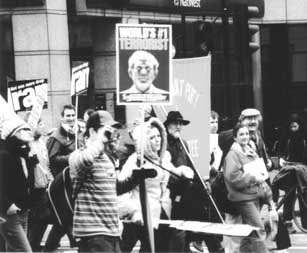 PROTESTERS DEMAND TROOPS OUT!
AROUND 100,000 people marched through the streets of London last week to call for an end to the illegal three-year invasion of Iraq and for British troops to be brought home. They also voiced their strong opposition to the threat of a possible air strike against Iran.
The march, organised by Stop the War and CND, was one of many all around the world to mark the third anniversary of the morning that Bush declared war on Iraq: in Basra, Baghdad, Rome, New York, Sydney, Madrid, Dublin, Istanbul, Chicago, Toronto, Karachi and Dhaka. The march, from Parliament Square to Trafalgar Square, took a long route along Victoria Road, Buckingham Palace Road, Green Park, Piccadilly and the Haymarket. It passed the offices of Attorney General Lord Goldsmith, to underline the illegality of the war and that both Britain and the United States are guilty of war crimes.
The march ended in a huge rally in Trafalgar Square that was addressed by many speakers, including MPs and peace activists from many countries.
photo: Marching along with the NCP banner on Saturday
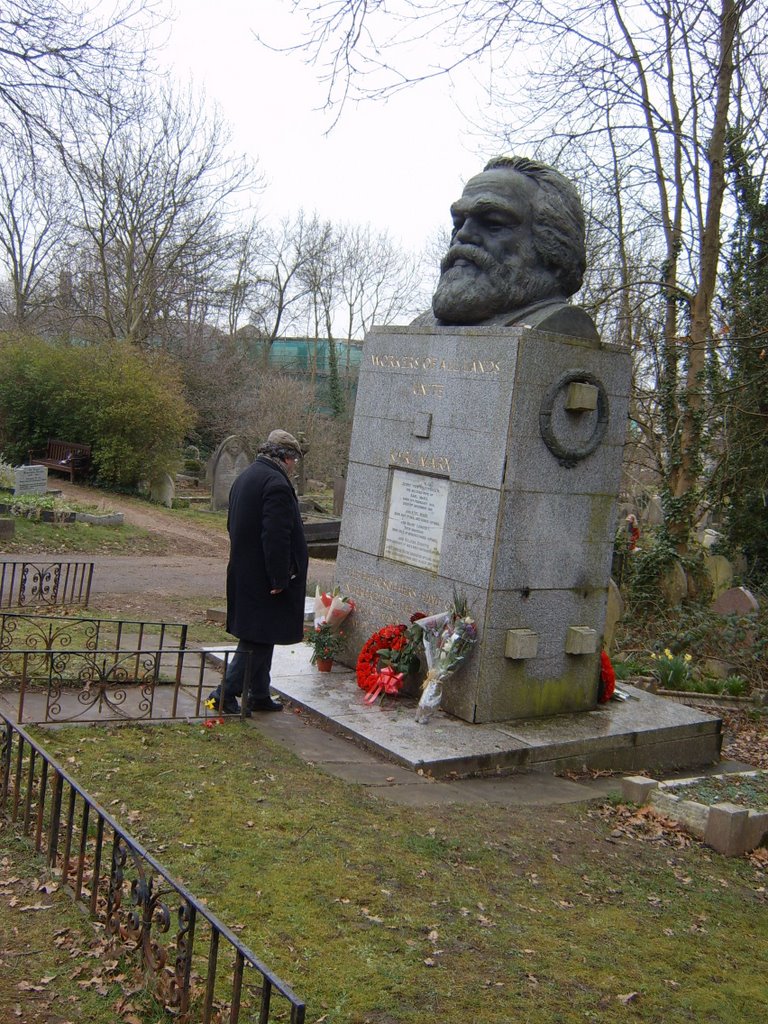 Tributes to Karl Marx
by Rob Laurie
Karl Marx died in his study at half-past two on the afternoon of Wednesday 14th March 1883. To commemorate his passing the Marx Memorial Library has for many decades held an annual graveside oration at his burial place in Highgate Cemetery in North London at the exact moment of his death.
This year the speaker was David McLellan. In addition to being the author of many well received books on Marx, David McLellan is both president of the Marx Memorial Library and Professor of political theory at the University of Kent.
In his address MacLellan stressed that the writings of Marx and Engels, although produced in the 19th century, are equally relevant for the 21st century. Indeed the first description of what is commonly known by the fashionable buzzword as “globalisation” appeared in the Communist Manifesto of 1848.
Marx’s view that to understand the world one needs to look first and foremost at the relations of production is as true today as it was when first formulated.
He concluded by observing that the remarks made by Frederick Engels at Marx’s funeral in 1883 have been vindicated by history: “His name and works will endure down through the ages”.
NCP leader Andy Brooks represented the New Communist Party and the turnout included Library committee members and delegations from the London embassies of socialist countries, including Cuba, People’s China, Vietnam and the DPR Korea, many of whom laid flowers at the grave. The turnout was swollen by the presence of a large group of young Chinese students studying at the University of Westminster.
This year was the also the 50th anniversary of the unveiling of the iconic memorial to Marx which was sculpted by Lawrence Bradshaw in 1956. A BBC radio reporter was on hand to record participants’ views on both Marx and the monument. Hopefully these remarks will be broadcast shortly.
Photo: NCP General Secretary lays flowers at Marx's grave
Monday, March 20, 2006
London news round-up
Eurostar cleaners ballot for strike
MORE THAN 100 members of the RMT transport union who are employed by OCS as cleaners on its Eurostar contract are to be balloted for industrial action over the company’s failure improve a pay offer that falls way short of eradicating poverty pay rates. Members are to be asked to vote to strike and for action short of strike to back their campaign for a minimum pay rate that matches London mayor Ken Livingstone’s recommendation of a living wage of at least £7.05 an hour. “OCS is paying cleaners as little as £5.50 an hour, even for nights, Sundays and bank-holiday work, and that is simply not good enough,” RMT general secretary Bob Crow said last week. “The paltry increase they are offering includes consolidation of a £10 weekly attendance bonus and boils down to an insult of 20p an hour and would still leave pay rates around £1 an hour below a living wage. “I am sure that Eurostar passengers will be horrified to learn that the people who clean their trains and stations are paid at such miserable rates. “If OCS can afford to pay their top director £175,000 a year and can stump up cash to sponsor a stand at the Oval they can afford to pay the people who actually make their money a decent wage. “And it is no use Eurostar burying their heads in the sand either. Poverty wages are being paid to cleaners working on their railway, and they also have a responsibility to stop it. “If OCS want to avoid industrial action it is up to them to come back to the talks table and negotiate decent pay rates,” Bob Crow said.
Rally against global warming
MORE THAN 20,000 people filled Trafalgar Square last Saturday in a mass rally to demand that the Government acts to tackle the threat of global warming. The event was organised by Stop Climate Chaos and supported by over 40 organisations, including Greenpeace, Friends of the earth, Oxfam, Make Poverty History, Surfers Against Sewage, the Women’s Institute and the Ramblers’ Association. It was timed to come just before the United Nations climate change talks in Nairobi and just after the Stern report into climate change. Those who came included walkers from the West Midlands, cyclists from Somerset and one man who paddled his canoe from Oxford. Ashok Sinha, the director of Stop Climate Change, said: “The event reflects how widespread the concern about climate change is. It is emerging out of the green box. People realise it’s not just an environmental question but a moral one.” The Bishop of Liverpool, James Stuart Jones, was critical of the Government stance on the environment; he said: “Ministers have lent their support to the Stern report on climate change, but, sadly, lent is the word because they give support one day and take it back the next.” A large contingent of the protesters marched past the US Embassy in Grosvenor Square on their way to Trafalgar Square to highlight the US position as the planet’s worst polluter.
Remembering the Soviet war dead
by New Worker correspondent
PAUL Kyriacou, the Mayor of Southwark and Philip Matthews of the Soviet Memorial Trust Fund last Sunday led a ceremony of remembrance at the Soviet war memorial, in the grounds of the Imperial War Museum, for the 27 million Soviet citizens killed in the Great Patriotic War against Nazi Germany. This year marks the 65th anniversary of the Battle of Moscow, considered to be one of the greatest battles of history. Nazi forces attempting to capture Moscow were halted and thrown back by the Soviet counter-offensive, which began on 5th December 1941. Wreaths were laid by the Mayor, by the local MP Simon Hughes, on behalf of the House of Commons, and by the Ambassador of the Russian Federation. Others who laid wreaths included the ambassadors of the Ukrainian Republic, Belarus, Turkmenistan, Kazakhstan and other former Soviet Republics; a representative of the RAF Russia Association, the Royal British Legion, the local branch of the trade union Ucatt and the Russia Convoy Club. The event was organised by the Soviet Memorial Trust.
Friday, March 03, 2006
An inquiry that's needed...
THE TORIES are not the best placed to talk about sleaze, given the record of the past Thatcher and Major governments, but that doesn’t mean their call for a public inquiry into the Jowell affair should be ignored.
Culture Secretary Tessa Jowell’s husband David Mills, an international lawyer who works for Italian premier Silvio Berlusconi, is accused of taking a £344,000 bribe from Berlusconi in return for providing false witness in court for his client. This, Mills denies.
While her husband’s business has nothing to do with her, the Sunday Times claims that Jowell signed a document to facilitate the transfer of this money to Britain.
According to the paper there is a link between a loan application she signed on the couple’s house and the money that Italian prosecutors allege was a bribe. This loan was then reportedly paid off some weeks later allegedly using money Mills received from Italy. Jowell categorically denies it was paid off with Berlusconi’s money. “I agreed that we would take out a loan on our house. That is not unusual, it’s not improper, and it’s certainly not illegal,” she told the media on Sunday. That being the case there should be no problem in meeting the Tory demand for an independent inquiry to see if the Labour politician has breached the ministerial code of conduct.
...and a panel that’s not
THE DISGRACEFUL suspension of Ken Livingstone as Mayor of London by the obscure and unelected Adjudication Panel of England has been frozen for the time being. But the verdict of this body, on behalf of the Standards Board for England, was unjust, inconsistent and plainly disproportionate to Livingstone’s alleged offence.
Last year a Tory Brent councillor was brought before the board for saying “Jews run everything in Britain and practically run America”. But while the board accepted that he had “expressed a controversial opinion that offended a member of the public”, no action was taken because this London Tory councillor had not committed “a criminal offence” nor had his remarks put “individuals or groups at risk”.
It’s a different tune when it comes to the Labour Mayor of London.
Livingstone claims that the London Evening Standard has pursued a 25-year vendetta against him. That’s not surprising as the paper is a consistent supporter of the Tory party. But celebrities and politicians must expect the attention of the paparazzi whether they like it or not. The Standard reporter who door-stepped a party at midnight to catch Livingstone off-guard was doing his job. Equally Livingstone was entitled to tell him where to get off.
Comparing the reporter, who is Jewish, to a German war criminal and a “kapo”, a term the Nazis used for Jewish collaborators in the concentration camps, was as offensive as it was intended to be. But it clearly wasn’t racist or anti-semitic – a fact the Board of Deputies of British Jews, who made the complaint, recognise.
Nevertheless the three-strong panel asked to consider their complaint, deemed that Livingstone’s conduct was “unnecessarily insensitive and offensive” and had brought his office into disrepute, ruling that the Mayor should be suspended from office for a month.
Livingstone has quite rightly vowed to appeal and take this case through the courts if the decision is not rescinded. Though the panel has the powers to punish those it decides have breached the standards code, the Mayor points out that the code itself is going to be amended by the Government to restrict it “only to matters which would be regarded as unlawful”.
Ken Livingstone has been a forthright opponent of racism and fascism throughout his political life. No one seriously believes this incident was no more than a storm in a tea-cup inflated by those who seek to discredit the Mayor and the London Labour Party.
The suspension, which cuts across the democratic rights of Londoners who voted Livingstone in, must be dropped.
Culture Secretary Tessa Jowell’s husband David Mills, an international lawyer who works for Italian premier Silvio Berlusconi, is accused of taking a £344,000 bribe from Berlusconi in return for providing false witness in court for his client. This, Mills denies.
While her husband’s business has nothing to do with her, the Sunday Times claims that Jowell signed a document to facilitate the transfer of this money to Britain.
According to the paper there is a link between a loan application she signed on the couple’s house and the money that Italian prosecutors allege was a bribe. This loan was then reportedly paid off some weeks later allegedly using money Mills received from Italy. Jowell categorically denies it was paid off with Berlusconi’s money. “I agreed that we would take out a loan on our house. That is not unusual, it’s not improper, and it’s certainly not illegal,” she told the media on Sunday. That being the case there should be no problem in meeting the Tory demand for an independent inquiry to see if the Labour politician has breached the ministerial code of conduct.
...and a panel that’s not
THE DISGRACEFUL suspension of Ken Livingstone as Mayor of London by the obscure and unelected Adjudication Panel of England has been frozen for the time being. But the verdict of this body, on behalf of the Standards Board for England, was unjust, inconsistent and plainly disproportionate to Livingstone’s alleged offence.
Last year a Tory Brent councillor was brought before the board for saying “Jews run everything in Britain and practically run America”. But while the board accepted that he had “expressed a controversial opinion that offended a member of the public”, no action was taken because this London Tory councillor had not committed “a criminal offence” nor had his remarks put “individuals or groups at risk”.
It’s a different tune when it comes to the Labour Mayor of London.
Livingstone claims that the London Evening Standard has pursued a 25-year vendetta against him. That’s not surprising as the paper is a consistent supporter of the Tory party. But celebrities and politicians must expect the attention of the paparazzi whether they like it or not. The Standard reporter who door-stepped a party at midnight to catch Livingstone off-guard was doing his job. Equally Livingstone was entitled to tell him where to get off.
Comparing the reporter, who is Jewish, to a German war criminal and a “kapo”, a term the Nazis used for Jewish collaborators in the concentration camps, was as offensive as it was intended to be. But it clearly wasn’t racist or anti-semitic – a fact the Board of Deputies of British Jews, who made the complaint, recognise.
Nevertheless the three-strong panel asked to consider their complaint, deemed that Livingstone’s conduct was “unnecessarily insensitive and offensive” and had brought his office into disrepute, ruling that the Mayor should be suspended from office for a month.
Livingstone has quite rightly vowed to appeal and take this case through the courts if the decision is not rescinded. Though the panel has the powers to punish those it decides have breached the standards code, the Mayor points out that the code itself is going to be amended by the Government to restrict it “only to matters which would be regarded as unlawful”.
Ken Livingstone has been a forthright opponent of racism and fascism throughout his political life. No one seriously believes this incident was no more than a storm in a tea-cup inflated by those who seek to discredit the Mayor and the London Labour Party.
The suspension, which cuts across the democratic rights of Londoners who voted Livingstone in, must be dropped.
Subscribe to:
Posts (Atom)