Showing posts with label seminar. Show all posts

Tuesday, October 06, 2026

The way forward under Burnham


by New Worker correspondent

Comrades and friends spent the best part of the day pondering on the problems of the labour movement at the NCP Party Centre last weekend. Which way forward for the labour movement was the topic for discussion at the seminar opened by NCP National Chair Richard Bos on Sunday morning. Not an easy question to answer was the response from NCP leader Andy Brooks, who followed with a summary of the Party’s electoral policy since its foundation in 1977 and its current position of backing Labour or independent Labour candidates with mass support that was adopted in 2000 to support Ken Livingstone’s successful bid to become Mayor of London. 
Keynote contributions from British Posadist Marie Lynam and Ian Donovan of the Consistent Democrats sparked off a discussion that continued for the rest of the day. Participants, which included online comrades from East Anglia and Scotland, looked at where did the Corbynistas lose their way, the merits or otherwise of George Galloway’s Workers’ Party of Britain and the current position of the new Labour leadership under Andy Burnham,
Needless to say there was no conclusion apart from the general consensus that these forums should continue with the focus again on the problems and challenges that the working class face today in Burnham’s Britain. The New Worker plays its part in that struggle and after a rousing appeal from Richard Bos £117 was collected for the fighting fund!

Sunday, March 29, 2026

China charts the future!

by New Worker correspondent
Zheng Zeguang opens the seminar

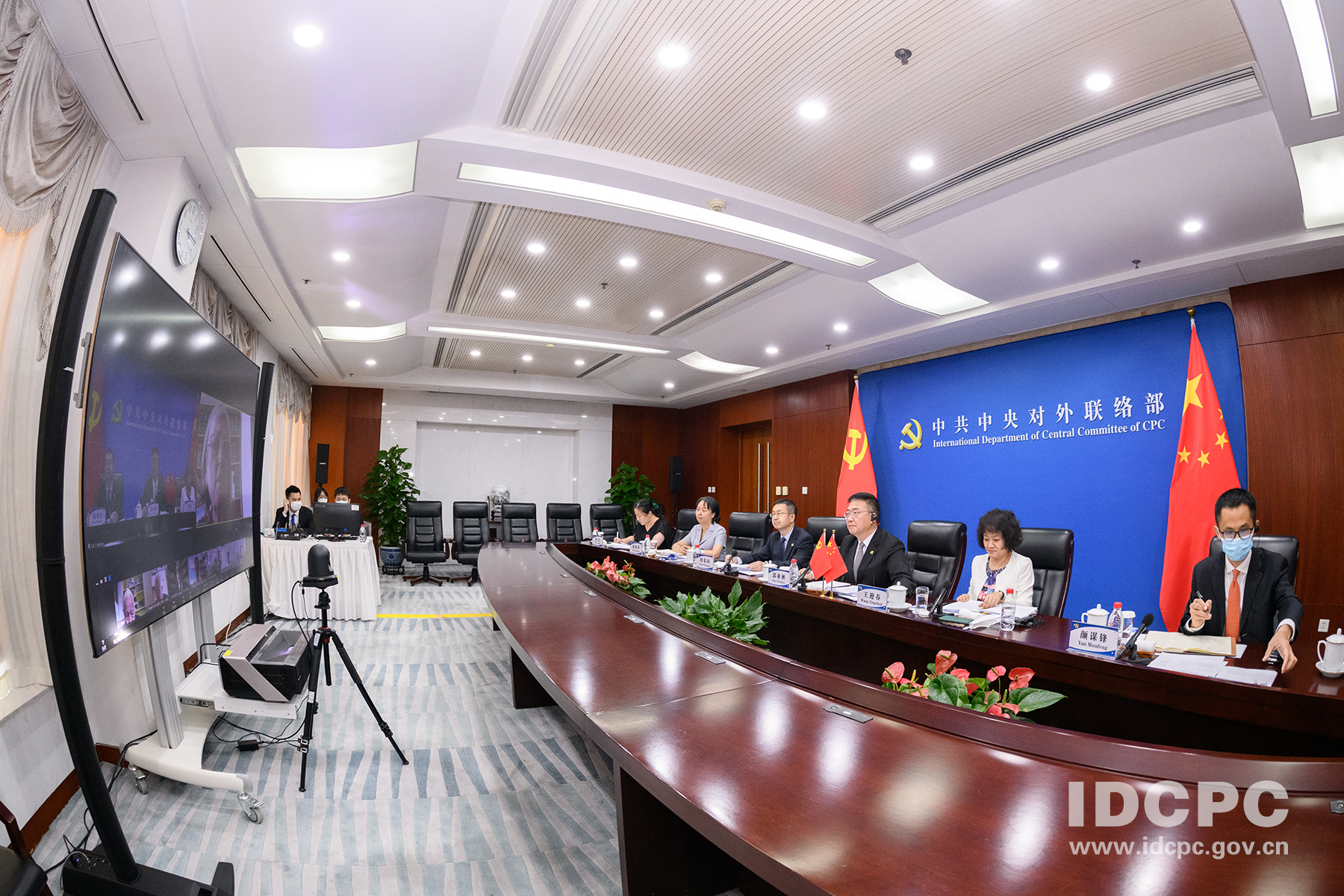
NCP leader Andy Brooks joined social scientists, businessmen and other communists for a seminar at the Chinese embassy in London last week. The participants, which included solidarity campaigners, academics and politicians like Vince Cable, the former Liberal-Democrat leader, all spoke on the importance of the “two sessions” – the annual meetings of China’s highest civic authorities that were held in Beijing last month. 
Chinese ambassador, Zheng Zeguang, opened on the new developments in China and the opportunities it gave to the world that was the theme of the symposium and the discussion that followed.
He said that in the international arena unilateralism and bullying are on the rise, regional conflicts persist, and the international order is facing serious challenges. The more turbulent the world becomes, the greater the need to promote dialogue and co-operation. 
Ambassador Zheng highlighted that the implementation of the current Five-Year Plan will bring new opportunities for the development of other countries and open up new prospects for China-UK cooperation. China will work with the UK in the same direction to follow through on the important common understanding reached between the leaders of the two countries and the outcome of Prime Minister Keir Starmer’s visit to China. It is important that China and the UK strengthen exchanges at all levels, expand practical cooperation, properly manage differences, and continue to enrich the long-term and consistent comprehensive strategic partnership, in order to deliver greater benefits to the two peoples and make due contributions to world peace, stability and prosperity.
In his contribution Andy Brooks said “This has been a stormy month. While the millions upon millions of people in all five continents recoiled in shock and horror at the American-Israeli onslaught on Iran plunging the Middle East into the flames of a war that threatens the entire stability of the world another event – in the heart of China – charted the future not only for the Chinese people but for the cause of peace and socialism throughout the world.
“The Chinese revolution that established the people’s government in 1949 has transformed the country that was then the poorest in the world. China has now risen from being a weak semi-feudal, semi-colonial country to becoming a force for peace in the global arena, with the second largest economy in the world. Productivity gains, innovation and consumption need have become the main drivers of growth.  As a major manufacturing country, China's manufacturing, innovation and construction will continue to serve the world during the 15th Five-Year Plan period. As China transforms it shares what it has learned from managing large transitions at scale with other developing countries facing similar development challenges. And the communist party which led and continues to lead the Chinese people’s march to socialism equally is always ready to share its knowledge and experience with the rest of the communist movement around the world.
“Democracy is a shared value of humanity and a right of the people of all countries. In China a prosperous society is being created for everyone to enjoy.  And people’s democracy is an instrument to solve problems for the people who are the masters of the country. We see it in the Two Sessions and in the words and deeds of the Communist Party of China”.

Monday, November 03, 2025

New challenges for China

by New Worker correspondent
Zheng Zequang opens the seminar

NCP leader Andy Brooks joined social scientists, businessmen, solidarity workers and other communists for an economic seminar at the Chinese embassy in London last week. 
And the Chinese ambassador, Zheng Zeguang, opened on the new developments in China and the opportunities it gave to the world that was the theme of the symposium and the discussion that followed.
He said China is marching towards the second Centenary Goal – a call to action for the entire country to seize the momentum and advance Chinese modernisation.
With this meeting, the Communist Party of China with Comrade Xi Jinping at its core sets to unite and lead the Chinese people to write yet another chapter on the miracles of rapid economic growth and long-term social stability and to open up new horizons for Chinese modernisation.
China was ready to share opportunities and seek common development with the world. China cannot develop in isolation from the world, while the world cannot prosper without China. While pursuing modernisation, China will strive to safeguard world peace and development.
Zheng pointed out that since last year, under the strategic guidance of the leaders from both China and Britain, positive progress has been made in China-UK relations. But, from time to time, this relationship has also been undermined by anti-China forces. The improvement and development of China-UK relations is in the fundamental interest of people in both countries, and it requires the concerted efforts of both sides.
The UK side should have the right perspective. Those who attack China by touting "China threat" and fabricating lies are ignorant and arrogant. They do not represent the mainstream of the UK, and their attempts are doomed to failure. Both sides should uphold mutual respect and non-interference in each other's internal affairs. The UK must honour its commitment, and properly handle Taiwan-related issues in accordance with the one-China principle. The two sides should commit to mutually-beneficial cooperation, create new highlights of cooperation and bring more benefits to the two peoples.
In his contribution Andy Brooks said “stable growth, stable policies and stable expectations – this is what the people want. China's development follows a clear direction that is taken with confidence and determination...this is China’s answer to Western calls for tariff walls and trade wars. China's approach to development is not about fighting for your own corner but about serving the people for the benefit of the entire world...
“The imperialists think that their guns will ensure that they can ignore the will of the people for as long as they like. But they were proved wrong in the 20th  century and they will be proved wrong today. The days when people listened to the rich men who told us that the greatest virtue of humanity was the possession of the largest amount of money are over...
Everywhere we look in the capitalist world we see unemployment, homelessness, poverty, drug abuse and crime. The symptoms of industrial decline, inflationary pressures, stock market volatility and economic stagnation. This is capitalism. And working people are being made to carry the burden of its failure. But in People’s China working people aren’t simply reacting to global challenges – they are shaping the very future of our world”. 

Monday, March 31, 2025

China’s next steps in 2025

Ambassador Zheng opens the seminar
by New Worker correspondent

NCP leader Andy Brooks joined other communists, academics and businessmen at a symposium at the Chinese embassy last week that looked to the future following the conclusion of the annual meeting of China’s highest civic bodies. There, in Beijing, the annual legislative sessions of the National Committee of the Chinese People's Political Consultative Conference (CPPCC) and the National People's Congress (NPC) was the focus of discussions on the way forward for the people’s government and the 1.4 billion people it represents.  
The ‘two sessions’ are always significant events in the Chinese people's political life, bringing together thousands of deputies and delegates from every corner of the country and all walks of life. Their proposals are aimed at solving everyday issues to build a better life for the people. 
Ambassador Zheng Zeguang said that given the evolving international and domestic landscape this year's Two Sessions attracted even greater attention and carried profound significance.
The Two Sessions demonstrated the Chinese people's confidence, resolve, and their spirit of unity and readiness to take action. They also projected China's main economic and social development targets and outlined a series of important policy measures. 
The Chinese leadership made it clear that challenges arising from reform and opening up can only be solved by pressing ahead with reform and opening up, demonstrating a firm determination to address the risks and obstacles on the path ahead. The Two Sessions also highlighted the unique advantages of China's political system. They serve as a vivid practice of  ‘whole-process people's democracy’ under the leadership of the Communist Party of China.   
The British representatives at the symposium acknowledged that with increasing global uncertainties and instabilities, the current international landscape is undergoing its most profound changes since the end of the Second World War. 
As Andy Brooks noted “the new Trump administration has changed tack in a bid to end Biden’s proxy war against Russia and establish a new detente with the Kremlin. This decision reflects the needs and demands of the wing of the American ruling class that wants to cut its losses in Ukraine to enable them to strengthen their grip over the Middle East in their efforts to control the entire global energy market. 
“Spurning the United Nations some of the Trump team talk a “new Yalta” that would redefine the world into spheres of influence while retaining the lion’s share for American imperialism. At the same time the Trump administration seeks to “Make America Great Again”, largely at the expense of its own allies, and boost American manufacturing through tariffs and protectionism while using secret diplomacy and economic blackmail to achieve its goals.
“Both the Russian and American sides are clearly working towards a win-win agreement over Ukraine. If that ends the war with a peace settlement that recognises the rights of the Crimeans, southern Ukrainians and the people of the Donbas to live in the Russian Federation well and good. But secret diplomacy is rarely the best pathway to peace. 
“In these turbulent times China is a stabilising force ready to defend world peace. People’s China has taken the lead in helping to build the economies of the Global South while working for peace and harmony throughout the world”.

Saturday, October 19, 2024

Which way forward following the election…

by New Worker correspondent

That was the question posed at a seminar in London on Sunday. The 30th anniversary of the  start of the dialogue between the NCP and the RCPB (ML) was appropriately marked by the opening of a discussion that both parties believe needs to be taken throughout the labour movement. NCP leader Andy Brooks, who chaired the meeting at the NCP Centre, welcomed everyone to the seminar at the Sid French library or by video link and the discussion was opened by Michael Chant, the RCPB (ML) leader. 
Michael reviewed the work of both parties over the years and presented views on the tasks and vantage point of the communists at this significant time in history. Other comrades. including supporters of the Consistent Democrats platform and the British Posadists, also spoke on the Tasks of the Communists in the Light of the July 2024 General Election – to look at the meaning of Labour’s immense but essentially hollow victory in July, Jeremy Corbyn’s new Independent bloc in Parliament and the predictable failure of the revisionists and the conventional social-democratic left at the polls. We discussed the mass support for the Palestinians on the street as well as the upsurge of racist violence and the mass anti-fascist response that followed and the need for a renewed fight-back against Starmer-style austerity that must be led by the rank-and-file in the trade unions and the mass movements of the labour movement. Finally it was agreed to broaden the discussion by publishing the contributions in both parties’ journals and to hold other meetings and seminars in the very near future.

Friday, March 08, 2024

People’s China and the world we want

the CPB's Rob Griffiths and Andy Brooks
by Andy Brooks

New Communist Party leader Andy Brooks took part in a seminar on China’s diplomacy and building a community with a shared future for humanity at the Chinese embassy in London in February. This is his contribution to the discussion.

The key issue of the 21st century is what kind of world do we want and how are we going to build it. It revolves around peace. The struggle to abolish nuclear weapons is crucial for the survival of humanity and eliminating the causes of war is central to averting a Third World War. That is why communists have always understood that the struggles for peace and socialism are indivisible. The Chinese communists are striving to achieve lasting world peace, so that all countries can enjoy a peaceful and stable external environment and their people can live a happy life with their rights fully guaranteed to build a world that is free from fear and enjoys universal security. China’s perspective is based on the concept of ‘one country, two systems’ and the principle that ‘a nuclear war cannot be won and must never be fought’. But the most aggressive sections of the American ruling class now at the helm in Washington clearly believe in “one world, one system” and that nuclear war is, under certain circumstances, entirely winnable.
This is the era of the “global village” and “globalisation”. But what does that actually mean? It clearly means different things to different people.
For China and the other countries of the Global South it means working together to build a universally beneficial and inclusive economic global system that meets the common needs of all countries, especially the developing countries, and properly addresses the development imbalances between and within countries resulting from the global allocation of resources.
In America, however, globalisation simply means US hegemony. Some call it the “new world order” – others the “American dream in the 21st century” but there’s nothing new about the American dream of world domination. 
US imperialism and it lackeys destroyed the Yugoslav federation and the Libyan Jamahuriya. It fans the flames of war in Ukraine and the Middle East, blocks the return of Taiwan to its Chinese homeland and prolongs the unhappy partition of many countries including Cyprus, Kashmir and Korea. US imperialism has, indeed, established its hegemony over Western Europe – forcing British, French and German imperialism to accept the model of subservience imposed on Japan by US imperialism in 1945. 
This is what the Americans call the “free world” and “rules-based” order. But the “freedom” they recognise is that which allows the big corporations to exploit and plunder and the only rules are Rudyard Kipling’s rules of the jungle. But the dreams of the bourgeois elites who talked about the ‘end of history’ and a new golden age of capitalism that they said would inevitably follow the collapse of the Soviet Union died on the streets of Baghdad and the hills of Afghanistan.
  Wherever there is oppression, there is resistance and now imperialism is on the defensive. The Palestinian Arabs keep up the fight against Zionist aggression. Cuba, Iran and the DPR Korea stand firm in the face of the US blockade and the people of the Donbas remain steadfast in resisting the Nato-backed Ukrainian onslaught.
Capitalism is in the throes of a deep crisis. The slump that began in 2008 continues without any sign of real recovery while China and the Global South build an alternative economic and political system based on mutually advantageous terms and equal shares for all.
Some 85 per cent of the world’s population live in the Global South – the ‘developing’ world that is still largely excluded from the international institutions set up by US imperialism after the Second World War with the support of the weaker imperialist forces who rely on American might to defend their global interests now that their colonial empires have long gone. 
The people of the Global South are sick and tired of the fact that the Americans and their minions in Western Europe have economically dominated the world for decades, forcing and imposing transactions in dollars with the fear that failure to comply with US directives would result in economic and financial sanctions or even “regime change” à la Iraq and Libya.  
Now new structures like the BRICS bloc are challenging the old imperialist system of oppression and exploitation. The BRICS bloc, named after Brazil, Russia, India, China and South Africa who set it up some 15 years ago, has become a pivot for the Global South in the struggle to end the economic and political stranglehold of Anglo-American and Franco-German imperialism in Africa, Asia and Latin America.
BRICS is open to helping countries develop, as well as promoting investment and trade without strings or preconditions. BRICS is fighting against the concept of a new Cold War and opening the possibility of building a fairer and more equitable international economic order from which the world can benefit. The BRICS bloc is helping to build the multi-polar world that will put an end to the American dream of the “new world order” and world domination. No wonder Argentina, Egypt, Iran, Ethiopia, the United Arab Emirates and Saudi Arabia have applied to join the group. Many more will follow in the future.
A new world is indeed possible but it’s not the European Union or the hell-hole of the United States.  It’s the world being built now in People’s China and the new institutions of the Global South that offer an even playing field to all countries to trade and peacefully resolve disputes to build a better future for everyone on the planet.

Friday, March 01, 2024

China’s path for peace and socialism

Zheng Zeguang opens the seminar
by New Worker correspondent

NCP leader Andy Brooks took part in a seminar with other communists, academics and businessmen at the Chinese embassy in London last week to celebrate the Chinese New Year and engage in in-depth discussions on China’s socialist path and the global significance of building a community with a shared future for humanity.
The Chinese ambassador, Zheng Zeguang, delivered a keynote address in which he pointed out that building a global community with a shared future is the core tenet of Xi Jinping Thought on diplomacy. It is the Communist Party of China’s answer to the question of what kind of world we should build and how to build it. It is also the noble goal pursued by China in conducting major country diplomacy with Chinese characteristics in the new era.
He pointed out that this has developed from a conceptual proposition to a scientific system, from a promising vision to substantive actions and from a Chinese initiative to an international consensus that has become a glorious banner leading the progress of the times.
 Over the past year China’s economy grew by 5.2 per cent, contributing about one-third of the global economic growth. China's rapid green and low-carbon transition propelled global sustainable development. And China shared more development opportunities with the world through expanded high-level opening up.
China made active efforts to improve relations between other major countries, successfully mediated a historic reconciliation between Saudi Arabia and Iran, and played a constructive role in addressing regional hotspots such as the Palestine-Israel conflict and the Ukraine crisis, making new contributions to world peace.
China actively contributed to the UAE Consensus at the COP28 UN Climate Change Conference, enhanced solidarity of the Global South, promoted the historic expansion of BRICS and gave support to the African Union in joining the G20, playing an important role in improving global governance.
Ambassador Zheng said People’s China is calling for an equal and orderly multipolar world and a universally beneficial and inclusive economic globalisation. “We will work with all countries to build a community with a shared future for mankind. We call on all countries to uphold dialogue and cooperation and oppose rivalry and confrontation, uphold peace and stability and oppose conflict and war, uphold openness and inclusiveness and oppose “decoupling” and suppression, uphold mutual learning and oppose clash of civilisations, and uphold true multilateralism and oppose unilateralism and bullying” he declared.
China's commitment to interpreting and promoting building a community with a shared future for mankind through its actions serves as a model for the international community. Western disinformation cannot hide this truth as China's proposal and practice are being welcomed and endorsed by a growing number of countries and their people. The participants expressed their readiness to strengthen exchanges and dialogue with China, and make unremitting efforts to build a better world.

Sunday, September 10, 2023

People’s China: taking the lead for peace


New Communist Party leader Andy Brooks took part in a seminar on the role of the Communist Party of China and the world today at the Chinese embassy in London in August. This is his contribution to the discussion.

We meet at a time of sharpening contradictions — and the primary contradiction in the world today is between United States imperialism and the rest of the world it seeks to dominate..
    Generations of Chinese communists struggled against dogmatism and sectarianism to build a people’s democracy in their own way, to serve the needs of the working people of China and throughout the wider world we live in – a world torn apart by war and stricken by poverty and disease. While the American imperialists incite conflict and sectarian division People’s China has taken the lead in helping to build the economies of the Global South while working for peace and harmony throughout the world,
    We too must struggle for peace and nuclear disarmament – as well as the abolition of other weapons of mass destruction.
    Imperialism fans the flames of war in Ukraine and the Middle East, blocks the return of Taiwan to its Chinese homeland and prolongs the unhappy partition of many countries including Cyprus, Ireland, Kashmir and Korea. China’s perspective, on the other hand, is based on the concept of ‘one country, two systems’ and the principle that ‘a nuclear war cannot be won and must never be fought’. But the most aggressive sections of the American ruling class now at the helm in Washington clearly believe in “one world, one system” and that nuclear war is, under certain circumstances, entirely winnable.
    The Chinese revolution that established the people’s government in 1949 has transformed the country that was then the poorest in the world. Since then China has risen from being a weak semi-feudal, semi-colonial country to become a force for peace in the global arena with the second largest economy in the world.
    People’s China, the fifth permanent member of the United Nations Security Council, is the only veto-power actively supporting proposals for multilateral nuclear disarmament. Pledging never to be the first to use nuclear weapons in any conflict, China stands for the complete prohibition and total destruction of all atomic weapons.
    China, backed by many other countries, has repeatedly challenged the West to implement the entire non-proliferation treaty, signed in 1968, that not only called a halt to nuclear proliferation but also committed the signatories to work towards universal nuclear disarmament.
    The struggle to abolish nuclear weapons is crucial for the survival of humanity. But central to averting a Third World War is the need to eliminate the causes of war. And that is why communists have always understood that the struggles for peace and socialism are indivisible.
    The Chinese communists are striving to achieve lasting world peace, so that all countries can enjoy a peaceful and stable external environment and their people can live a happy life with their rights fully guaranteed to build a world that is free from fear and enjoys universal security. 
    This is, of course, a quantum jump from the post-war Soviet policies of “peaceful co-existence” and “detente” that failed to end the Cold War and probably accelerated the collapse of the USSR. Peaceful co-existence mistakenly believed that the capitalists could be economically beaten at their own game while detente was, in essence, a futile Soviet attempt at achieving nuclear parity with the Americans to divide the world into Soviet and American spheres of influence.
    Sadly the United Nations has been marginalised by the imperialists who only pay lip service to UN institutions when it suits their purposes. When it doesn’t the world forum is ignored and discarded.
    So though the United Nations remains a prime focus China has taken the initiative in setting up other platforms for economic and diplomatic co-operation including BRICS, the Belt & Road Initiative and the Shanghai Co-operation Council.
    China has become a beacon of hope for all the peoples of the world struggling to build their own independent economies without imperialist interference. While Anglo-American and Franco-German imperialism use their military and economic might to impose their neo-colonial rule throughout the Global South the Chinese people can, and do, provide the countries of Africa, Asia and Latin America with an alternative source of high technology and economic assistance without the odious strings attached that always go with deals with the West.
    China puts people first. China has become a pivot for peace in a world torn apart by imperialist greed and aggression. China is strong but it threatens no one. China respects the sovereignty and territorial integrity of all countries. It stays true to the principle of equality of all countries big or small, strong or weak, and rich or poor, and it respects the development paths and social systems independently chosen by all the world’s peoples. The people’s government is dedicated to promoting a human community with a shared future.
    China stands ready to work with all countries and peoples who love peace and aspire to happiness to address all kinds of traditional and non-traditional security challenges, protect the peace and tranquility of the planet, and jointly create a better future for humanity, so that the torch of peace will be passed on from generation to generation and shine across the world.
    Earlier this year the Chinese leader, Xi Jinping, launched the “global security initiative” that lays out core concepts and principles regarding global peace and security.
    The first is to eliminate conflict through the establishment of a balanced, effective, and sustainable security framework under which countries respect the legitimate security concerns of each other and promote political solutions to cope with hotspot issues.
    The second is the promotion of economic development in the Global South.
    The third is respect for diversity. It is the right of every country to choose its own political system and development path.
    Finally all international disputes should be resolved through dialogue not unilateralism and hegemonic acts. The UN can play a positive role in international affairs if the voice and representation of countries throughout the Global South is expanded in the world forum.
    This is what we should all be working for. Hopefully we will live to see it happen in the years to come.


Sunday, August 27, 2023

China: Expanding horizons for peace

 by New Worker correspondent
Andy Brooks speaking


NEW COMMUNIST Party leader Andy Brooks took part in a seminar with other communists, academics and solidarity activists on the role of the Communist Party of China and the world today at the Chinese embassy in London this week.
The NCP delegation, that included national organiser Theo Russell, joined Robert Griffiths, the General Secretary of the Communist Party of Britain and Ella Rule, the Chair of the CPGB (ML) in the discussion that looked at China’s new Global Security Initiative and its long-standing efforts to promote sustainable development in the Global South and throughout the rest of the world.
The symposium was opened by Ambassador Zheng Zeguang who said that the Chinese people are acting upon the goals set forth at the 20th Congress of the Communist Party of China and working hard to achieve the rejuvenation of the Chinese nation through a Chinese path of modernisation. “We are also taking concrete steps to promote high-quality development. Many British friends who have recently visited China are amazed by the prominent progress China has made over the past few years in green and low-carbon development and the digital economy. And they are full of confidence for China’s economic progress”.
People’s China has always upheld the principle that all countries, big or small, are equal. “We never engage in economic coercion, and we oppose bullying and coercion by others. It’s only when China’s core interests are undermined by certain countries that we take legitimate and reasonable counter-measures”. 
In his opening Andy Brooks said “imperialism fans the flames of war in Ukraine and the Middle East, blocks the return of Taiwan to its Chinese homeland and prolongs the unhappy partition of many countries including Cyprus, Ireland, Kashmir and Korea. China’s perspective, on the other hand, is based on the concept of ‘one country, two systems’ and the principle that ‘a nuclear war cannot be won and must never be fought’. But the most aggressive sections of the American ruling class now at the helm in Washington clearly believe in “one world, one system” and that nuclear war is, under certain circumstances, entirely winnable”. 
China is striving to achieve lasting world peace through the traditional United Nations framework and through other platforms for economic and diplomatic co-operation including BRICS, the Belt and Road Initiative and the Shanghai Co-operation Council.
This, the NCP leader said, “was a quantum jump from the post-war Soviet policies of “peaceful co-existence” and “detente” that failed to end the Cold War and probably accelerated the collapse of the USSR. Peaceful co-existence mistakenly believed that the capitalists could be economically beaten at their own game while detente was, in essence, a futile Soviet attempt at achieving nuclear parity with the Americans to divide the world into Soviet and American spheres of influence”. 
China, backed by many other countries, has repeatedly challenged the West to implement the entire non-proliferation treaty, signed in 1968, that not only called a halt to nuclear proliferation but also committed the signatories to work towards universal nuclear disarmament. 
The struggle to abolish nuclear weapons is crucial for the survival of humanity. But central to averting a Third World War is the need to eliminate the causes of war. And that is why communists have always understood that the struggles for peace and socialism are 
indivisible.

Sunday, March 26, 2023

For a better, shared future for the peoples of the world

by New Worker correspondent


NCP leader Andy Brooks, along with Robert Laurie and John Maryon from the Central Committee of the New Communist Party, joined hundreds of other representatives from political parties and movements from around the world last week at an online seminar organised by the Communist Party of China in Beijing.
`    The meeting was opened by Xi Jinping, the General Secretary of the Communist Party of China and President of the People’s Republic of China. He was then followed by other leaders of the Global South including President Daniel Ortega of Nicaragua, South African President Cyril Ramaphosa and Venezuelan leader Nicolás Maduro as well as the presidents of Serbia and South Sudan and senior government figures from Grenada, Kazakhstan, Mongolia, Papua New Guinea, Russia, Timor Leste and Togo,
    Leaders of over 500 political parties and organisations from more than 150 countries attended the Communist Party of China in Dialogue with World Political Parties High-Level Meeting on 15th March. Together, they discussed the important theme of the Path Towards Modernisation: the Responsibility of Political Parties.
    The initiative calls for respect for the diversity of civilisations, upholding the common values of humanity in pursuing peace, development, equity, justice, democracy and freedom, and promoting robust international people-to-people exchanges and cooperation.
    In his opening remarks Comrade Xi Jinping gave Chinese answers to a series of thought-provoking questions such as "what kind of modernisation do we need and how can we achieve it”.
    "As our own future is closely connected with that of other countries and peoples, we will strive to provide new opportunities for world development, add new impetus to humanity's exploration of paths towards modernisation and make new contributions to the theory and practice of humanity's modernisation as we make new progress in Chinese modernisation", Xi said.
    Noting that the history of human development is full of twists and turns and that the path to modernisation is also arduous, Xi said that “in today’s world, multiple challenges and crises are intertwined. The global economic recovery remains sluggish, the development gap is widening, ecological environment is deteriorating, and the Cold War mentality is lingering,” meaning that we are once again at a crossroads of history.
    We must put the people first and ensure modernisation is people-centred. The ultimate goal of modernisation is the people’s free and well-rounded development. “Modernisation is not only about indicators and statistics on the paper but more about the delivery of a happy and stable life for the people.”
    We must uphold the principle of independence and explore diversified paths towards modernisation. Each country must consider its own national conditions and unique features. “It is the people of a country that are in the best position to tell what kind of modernisation best suits them. Developing countries have the right and ability to independently explore the modernisation path with their distinctive features based on their national realities.”
    We must uphold fundamental principles and break new ground. “We should work together to reform and develop the global governance system and make the international order more just and equitable as we advance humanity’s modernization in an environment of equal rights, equal opportunities and fair rules for all.” Xi added that we must help others to succeed while seeking our own success. “We stand firmly opposed to the practice of preserving one’s own development privilege by suppressing and containing other countries’ endeavour to achieve modernisation”.
    The Chinese leader noted that “the journey of over 100 years that the Party has traversed to unite and lead the Chinese people in pursuing national rejuvenation is also an exploration of a path towards modernisation.
    “Chinese modernisation is one of a huge population, of common prosperity for all, of material and cultural-ethical advancement, of harmony between humanity and nature, and of peaceful development,” adding: “We will stay committed to the right direction, right theories and the right path. We will not veer off course by changing our nature or abandoning our system...
    “China will neither tread the old path of colonisation and plunder, nor the crooked path taken by some countries to seek hegemony once they grow strong… we firmly oppose hegemony and power politics in all their forms…
    “The world does not need a new Cold War. The practice of stoking division and confrontation in the name of democracy is in itself a violation of the spirit of democracy…
    “no matter what level of development China achieves, it will never seek hegemony or expansion...there are bound to be setbacks on humanity’s journey to modernisation, but the future is bright”.
    In the history of humanity, over thousands of years, various civilisations have come into being, developed, and have in return promoted the overall development of human society. Diversity has been a prominent feature of civilisations.
    In spite of differences in histories, cultures, political systems and development phases, countries around the world share the common aspiration for peace, development, equity, justice, democracy and freedom – the common values of humanity.
    People need to keep an open mind in appreciating how different civilisations perceive values, and refrain from imposing their own values or models on others, and from stoking ideological confrontation.
    As the world is facing old and new challenges, there are more reasons for us to promote dialogue and consultation when addressing international issues, and to let cultural exchanges transcend estrangement, mutual learning transcend clashes, and coexistence transcend feelings of superiority.
    Spanning thousands of miles, the ancient Silk Road embodied the spirit of cooperation, mutual learning and mutual benefit. The year 2023 marks the 10th anniversary of a new “Silk Road” – China's Belt and Road Initiative (BRI), another project for the benefit of the masses which has brought tangible benefits to the people of the participating countries and promoted people-to-people exchanges.
    The diversity of civilisations is in nature a source of vitality and momentum in human development. Promoting people-to-people exchanges and mutual learning is of great value in summoning the enormous wisdom and energy needed to advance the progress and development of human civilisations.
    The BRI has delivered fruitful outcomes and won widespread support and participation. It has created jobs, improved infrastructure and promoted common development, especially in the developing countries.
    Security is the precondition for development. The Global Security Initiative calls for peacefully resolving differences and disputes between countries through dialogue and consultation, and supporting all efforts conducive to the peaceful settlement of crises.
    The recent Saudi Arabia-Iran dialogue in Beijing is a successful case of the practice of the Global Security Initiative, leading to the resumption of diplomatic ties between the two countries.
    The future of all countries are closely and increasingly connected. And tolerance, coexistence, exchanges and mutual learning among different civilisations play an irreplaceable role in advancing humanity's modernisation process.
    To realise a world with lasting peace and ever-improving welfare, we should embrace the Global Civilisation Initiative and draw on it to jointly create a better, shared future for humanity.
    Or as Xi Jinping says “a single flower does not make spring, while one hundred flowers in full blossom bring spring to the garden. Together, we can make the garden of world civilisations full of colours and life”.


Sunday, November 06, 2022

A New Journey for a New Era

Zheng Zeguang and Andy Brooks
by New Worker correspondent

NCP General Secretary Andy Brooks joined other communists, academics and friends of China at a seminar at the Chinese embassy in London on Monday. The symposium on the 20th National Congress of the Communist Party of China was opened by the Chinese ambassador Zheng Zeguang who gave a 20 minute summary of the main points of the Congress that met in Beijing last month.
    This was followed by short interventions by all the guests including the NCP leader who said: “the 20th Congress was a congress of victors and we are certain that there’ll be plenty more victories to come as the Chinese people march forward to build a modern, socialist China. The New Communist Party of Britain stands with the Communist Party of China in the common cause of the communist movement and we will continue to strive to strengthen the efforts of everyone working in solidarity and friendship with the Communist Party of China and the people of China”.

Saturday, August 20, 2022

There is only one China

by New Worker correspondent

NCP leader Andy Brooks took part in a seminar on the Taiwan issue at the Chinese embassy on 12th August together with members of Friends of Socialist China, the Society for Anglo-Chinese Understanding and the Chinese community in London.
    At the round-table discussion Ambassador Zheng Zeguang and other senior Chinese diplomats outlined the position of People’s China on the recent visit by the US House Speaker Nancy Pelosi to Taiwan.
    Ambassador Zheng said the question of Taiwan has become a “touchstone” for the healthy development of Sino-British relations in the new era. While the trans-Atlantic special relationship is a matter between the UK and the US it should not be used to undermine the core interests of China. On the Taiwan question, a major issue of principle, there is no reason for the UK to disregard facts and “play with fire” together with the US. Lessons from the past must be learned. Certain British politicians often put the Taiwan question on a par with the Ukraine issue, clamouring to “help Taiwan to defend itself”. Some MPs even talk about plans to follow up with visits to Taiwan. Such words and deeds are extremely irresponsible.
    The root cause of the current crisis lies in the moves of the US side and “Taiwan independence” separatist forces who constantly attempt to change the status quo in the Taiwan Strait. Over the years, the US has been playing the “Taiwan card” to contain China by approving arms sales to Taiwan, upgrading its relations with Taiwan, and hollowing out the one-China principle.
    Any move that violates the one-China principle or challenges the red line of the Chinese side will bring serious consequences to the China-UK relations.
    The Taiwan issue has always been a sensitive issue at the core of China-UK relations. China and the UK began to explore the establishment of diplomatic relations in the early 1950s, but it was not until 1972 that the diplomatic relations were upgraded to ambassadorial level, the central part of which is about the Taiwan issue. Only after the UK clearly recognised the Chinese government’s position that Taiwan is a province of the People’s Republic of China, revoked its official representative office in Taiwan, recognised the government of the People’s Republic of China as the sole legal government of China, and promised to maintain only an unofficial relationship with Taiwan that official diplomatic relations between China and the UK were established. This history must never be forgotten and the UK should honour its pledges.
    We are willing to make joint efforts with people from all walks of life in the UK to oppose division and confrontation, advance dialogue and cooperation, and maintain the healthy and stable development of China-UK relations. It is hoped that people of insight from all walks of life in the UK will join hands to oppose the irresponsible and detrimental remarks and moves of certain politicians.
    The Chinese side urges the decision makers in the UK to take concrete actions to abide by its commitment to the one-China principle, not to develop any form of official ties or military cooperation with Taiwan, stop arguing for the United States and the “Taiwan independence” separatist forces, and stop making any remarks or engaging in any activities that interfere in China’s internal affairs.
    Ambassador Zheng emphasised that in the past 50 years since the establishment of ambassadorial diplomatic relations between China and the UK, the exchanges and cooperation between the two countries have brought enormous benefits to the peoples of both countries. These outcomes are hard-won and must be cherished. China-UK relations are now at an important juncture. Here in the UK, the Conservative Party will elect a new leader and the country will have a new prime minister. All the relevant parties are following closely the trajectory of the UK’s policy on China.
    Around the world, severe challenges, such as the pandemic, economic downturn, energy shortages and climate change, remain. Under such circumstances, China and the UK should greatly strengthen rather than weaken cooperation. The two sides should follow the principles of mutual respect, equality and mutual benefit, adhere to the general direction of dialogue and cooperation, and join hands to address common challenges. This is the right choice that conforms to the fundamental interests of the peoples of both countries. We are willing to make joint efforts with people of insight from all walks of life in the UK to oppose division and confrontation, advance dialogue and cooperation, and maintain the healthy and stable development of China-UK relations.


Tuesday, June 07, 2022

China’s communists through the eyes of others

by Andy Brooks
Last week a video seminar was held as part of the events organised by the Communist Party of China in the run-up to its 20th National Congress this year. NCP leader Andy Brooks joined Rob Griffiths of the CPB, Ella Rule from the CPGB-ML, Keith Bennett from Friends of Socialist China, Carlos Martinez from the No Cold War movement and a representative of the CPB’s YCL to talk on the theme of the Communist Party of China in My Eyes. This is Andy Brooks’ contribution...

First of all I would like to thank our hosts for allowing me to say a few words about my impressions of the Communist Party of China which began when I first set foot in the people’s republic as part of a New Communist Party delegation that went to study economic reforms in the new enterprise zones in China back in April 1993.
    During the course of that visit we met a veteran Chinese communist who had fought the Japanese invaders and the reactionary forces during the civil war that ended in victory in 1949. He shared his memories of Harry Pollitt, who he had met when the British communist leader went to China in 1955, and he told us about the first steps taken by the communists along the road of socialist construction following the establishment of the people’s government in 1949.
    The Chinese comrade also spoke about the great changes in the countryside that had begun in 1979 and the development of the special zones that paved the way for the economic reforms that built the socialist market economy which is now the second largest in the world. He knew that dogmatists in some parts of the international communist movement didn’t understand the reform movement. But he said “what is the purpose of the Communist Party if it can’t raise the living standards of working people”.
    I have never forgotten that point. Sadly many European communists, east and west, did – leading to the fall of the Soviet Union and its allies in 1991 in the east and the collapse of communist and workers’ parties millions strong in western Europe.
    I don’t know whether that old Chinese communist lived to see the immense changes that have transform the towns and cities of China but we certainly have in subsequent visits to China over the past thirty-odd years.
    China has become a major force for peace. It has become a beacon of hope for all oppressed people.
It offers economic assistance to poor countries and has played an important role in helping the international efforts to combat the Covid pandemic.
    Cities have been modernised beyond recognition. Absolute poverty has been abolished Vast investments have created new industries to face the challenge of the 21st century and China is, once again, the work-shop of the world.
    Of course great cities are not unique to China. Monumental designs and towering blocks can be seen throughout the Western world. Modern cities house the banks and investment houses of capitalist speculation. Huge factories build the technology and the weapons needed to maintain the global system of oppression while the power of oil has transformed small fishing ports in the Persian Gulf into millionaires’ playgrounds. But this has not benefited the workers in the heartlands of imperialism while oil riches have not helped free the Palestinians or raised living standards on the Arab street.
    The immense wealth of the Western world remains in the hands of a tiny minority of capitalists and feudal lords.
    In the West millions of people scrabble to earn a living just to keep a roof over their heads, while a tiny elite live lives beyond the reach and often beyond the imagination of most workers.
    In the Third World millions upon millions live in poverty while their resources are plundered by the big Western corporations.
    We, on the other hand, see a different picture in China. Vast cities with modern offices and factories and equally modern housing for the workers who live there.
    Chinese astronauts circle the globe. A high-speed rail network spans the country. Container trains travel to Europe packed with the goods that fill our shops and markets. International airports link China to the four corners of the world. A growing network of domestic airline services and modern ports serve the seaborne trade that fires the global economy. And a state run education system and a dedicated health service that battled to contain the Covid plague is available to all.
    China’s wealth is being used to raise the standard of living of everyone in the people’s republic and help the development of the Third World through genuine fair trade and economic assistance.
    Though the social changes that inevitably followed the establishment of a mixed economy did lead to a rise in street crime it remains remarkably low compared to the norm in Europe and nothing like US or Latin American levels.
    There are no shanty-towns and slums in People’s China and the last vestiges of colonial rule, the shameful hovels in Hong Kong, will soon be swept away by the new government of the special administrative region.
    Big city pollution is being tackled by the people’s government in a meaningful way. The smog and acrid air has gone and blue skies have returned to Beijing following the national “war against pollution”, huge investments into a new regulations and an air pollution action plan that has transformed the capital and many other cities across the country.
    Over the years exchanges of views with the representatives of the Communist Party of China have deepened our understanding of the immense problems in organising the communist movement in such a vast country with such a huge population. We have also seen the immense achievements that China has made under the leadership of the Communist Party of China in overcoming poverty, providing the basic needs of all the people and tackling the population problem to give everyone a better life and a standard of living that is constantly rising.
    This year China’s communists will gather for their national Congress to chart the way forward for the Party and the country in the immediate future. Back in 2014 Communist Party of China (CPC) leader Xi Jinping said: "The very purpose of the CPC's leadership of the people in developing people's democracy is to guarantee and support the people’s position as masters of the country.”
    We are confident that the 20th Congress of the Communist Party of China will set the agenda for the people of China for many years to come. We wish the comrades success in their work and look forward to studying their conclusions in the future.


Sunday, February 13, 2022

What it means to be a communist

by New Worker correspondent

Andy Brooks 
London communists discussed the problems of our movement at a joint seminar at the New Communist Party Party Centre last weekend. Called by the NCP and the RCPB-ML, comrades spent Saturday afternoon looking at the question of “what it means to be a communist – new and revolutionary today” in the Sid French Library in south London.
    NCP leader Andy Brooks, who chaired the session, said he hoped this initiative would be the start of a wider discussion within the ranks of the communists and the basis for future joint work to continue the dialogue on the crucial questions facing the movement.
    Discussion on deeper issues has always been sadly lacking in London. Although it’s true to say that before Covid you could go to a different left event every day of the week in London, these meetings were really gatherings of the converted organised by left groups to rally their troops and mobilise them for the campaigns of the day.
    Immense amounts of time have been spent analysing the past and trying to come to terms with the counter-revolutions that brought down the Soviet Union and the people’s democracies of eastern Europe, but there’s been very little talk in preparing for the future.
    But discussion is a luxury we can afford – and we can start best by looking at what does it really mean to be a communist in the 21st Century.
    The RCPB-ML leader, Michael Chant, said in a keynote opening that; “Taking the topic at face value, and giving an answer in a nutshell, one could say to be a communist means seeing the face of the New in the crisis of the Old, and working for the necessary change, for the transformation of the Old into the New, with revolutionary sweep.”
    These factors were taken up by other comrades who raised the issue of communist morality and the role of women in the movement, along with taking the principled stand and building the united front in the struggles to come.
    The afternoon soon passed by, but it was agreed to broaden the discussion by publishing the contributions in both parties’ journals and to hold another seminar in the very near future.

Sunday, February 16, 2020

Which way forward for the labour movement?


By Theo Russell

New Communist party (NCP) comrades gathered at the party centre in London last weekend for a seminar to dissect the causes and consequences of the December General Election outcome for the Labour Party, and for the wider trade union and labour movement.
Whilst Labour’s drift in favour of a second Brexit referendum was seen as one of the key factors, especially in the leave-voting North of England seats, it was noted that Labour lost large numbers of votes not just to the Tories and the Brexit Party, but also to the Lib Dems and the Greens, as well as to abstentions.

A range of other factors also came up however:

·    the lacklustre campaign compared with 2017 when Corbyn took the fight to the Tories on the effects of austerity;
·    the intense media hostility, according to researchers, twice as bad as in 2017;
·    covert state interference, smear tactics and dirty tricks, including the secret Integrity Initiative army unit;
·    a large scale Tory campaign of proven lies on Facebook and other social media;
·    the illegal posting of placards the day of the election claiming that children would be unsafe under Corbyn;
·    and finally, the long-term decline in the Labour vote in seats where mines and factories have closed or moved away over several decades.

One comrade noted that media attacks on Rebecca Long-Bailey had already started, despite her clear efforts to back-pedal on Corbyn’s policies and her attack on his leadership.   Meanwhile the Labour Remainers haven’t given up and their candidate, Sir Keir Starmer, is getting an easy ride from the media.
In terms of other left and independent candidates, it was noted that Chris Williamson, the suspended left-wing ex-Labour MP, got only 635 votes in Derby North whilst George Galloway won 489 votes, both standing as independents.
Comrades also noted that the situation was not all doom and gloom however, with the Corbyn period winning back large numbers of Labour members and especially large numbers of new young members.
Labour still managed to win 10.3 million votes despite the massively hostile media onslaught, dwarfing the next largest national party, the Lib Dems, with 1.2 million and the Scottish Nationalists with the same. This compared with 9.5 million in 2005 – when Blair won with a comfortable majority – 8.6 million in 2010 and 9.35 million in 2015.
In 2017 under Corbyn, Labour won 12.97 million votes, only 1.7 million short of the party’s best ever performance, 13.94 million in 1951 when Clement Attlee also lost in a snap election.
In other words, Labour remains the second largest party and the party the overwhelming majority of the organised working class look to, and no other left party in Britain carries any weight whatsoever electorally.
However unpalatable the December election result, it is vital for Marxist-Leninists to have a thorough understanding of the future prospects for the labour movement and this seminar was another step in that learning process.
As we all know, the election may have been a victory for our class enemy, but capitalism’s problems, the growing opposition to massive inequality, job and housing insecurity, endless wars, rampant consumerism and environmental destruction, are not going to go away anytime soon.